


News Center
News Center
2021 wool textile industry operation stable quality, industry development toughness to enhance
Release time:
2022-02-12
2021 is the year of the 14th Five-Year Opening and a year of active recovery for the industry after the epidemic. In 2021, the wool textile industry experienced a strong rebound in early market demand, the medium-term new crown epidemic spread, raw material prices continue to fluctuate, the latter part of the region limited electricity production, the whole year offline circulation and freight is not smooth.
2021 is the year of the 14th Five-Year Opening and a year of active recovery for the industry after the epidemic. In 2021, the wool textile industry experienced a strong rebound in market demand in the early stage, the spread of the new crown epidemic in the medium term, the continuous fluctuation of raw material prices, the power limit in some areas in the late stage, the whole year offline circulation and freight is not smooth,
First, the wool textile consumer market plays a driving role
1, domestic and foreign market scale recovery, to help build a double-cycle new development pattern.
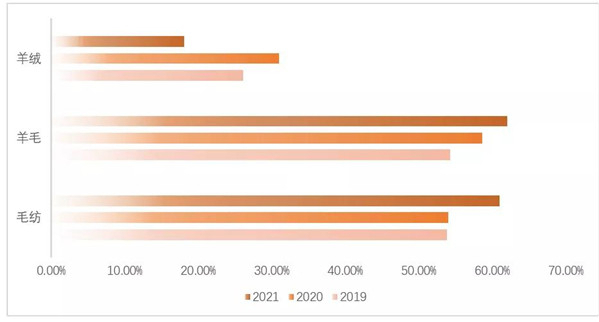
In 2021, the overall size of the wool textile market will recover significantly compared with 2020, and the domestic and international wool textile market will return to the level close to 2019, becoming the most important driving force for the industry. For the whole year, the domestic market has recovered from the haze of the epidemic in 2020, with the scale increasing by nearly 10 percentage points compared with the pre-epidemic 2019, and the overall domestic sales ratio of wool spinning exceeded 60%, an increase of 6 percentage points from 2020. Although the growth of domestic sales slowed down in the second half of the year, the contribution of the domestic consumer market to the recovery of the industry still exceeded that of the international market.
Among them, the proportion of domestic sales of wool textile products with wool as the main raw material has been increasing for two years. The export market with cashmere as the main raw material is more powerful.
Change of Domestic Sales Proportion of Wool Textile Industry from 2019 to 2021
Source: China Wool Textile Industry Association
2, the overall recovery of the domestic consumer market has not changed.
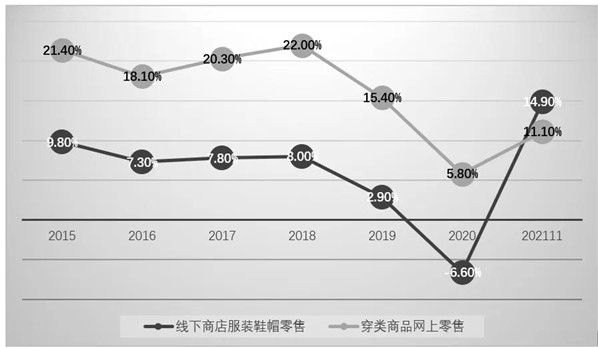
According to data from the National Bureau of Statistics, from January to November, the total retail sales of clothing, shoes and hats in physical stores increased by 14.9 year-on-year, and the online retail sales of wearing goods increased by 11.1. Although the domestic consumer market was affected by factors such as the multi-point spread of the epidemic, November The monthly retail sales of clothing goods declined slightly, and the decline narrowed month-on-month.
Changes in the growth rate of clothing retail consumption from 2015 to 2021
Source: National Bureau of Statistics
3, international wool textile consumption continued to recover
Worldwide, the main consumer market of wool textile showed a recovery trend. In 2021, the U.S. wool textile consumer market performed outstandingly, with U.S. imports of wool textile products totaling $3.14 billion from January to November, up 24% year-on-year. Wool textile consumption in the EU region is also in a recovering range. From January to August, imports of wool textile products from outside the region totaled about US $2.3 billion, an increase of 2.5 percent over the same period last year. Japan's wool textile market is relatively sluggish, with imports of wool textile products totaling $1.2 billion billion as of November, down 13% year-on-year, but the decline has narrowed significantly from the first half of 2021. With the recovery of international wool textile consumption, the proportion of China's wool textile products in the major consumer markets has increased, but compared with the pre-epidemic market share, China's product share still has further room to rise.
The export market of wool textile products also showed further improvement. According to China Customs data, from January to November, the export value of wool textile raw materials and products totaled US $12 billion billion, an increase of 30% over the same period last year, the highest growth rate in the past 10 years, and the annual export volume is expected to exceed the level of 2019. As of November, the trade competitive advantage index of wool yarn, wool knitted clothing, wool fabric and wool woven clothing products was 0.67, 0.56, 0.03 and 0.10 respectively, down slightly from last year, while blankets and artificial fur continued to maintain a high degree of competitiveness, with trade competitive advantage indexes of 0.99 and 0.85 respectively.
Wool textile exports and year-on-year changes from 2011 to 2021

Source: China Customs
The diversification of export markets has achieved remarkable results. In the first 11 months, China's wool textile exports to the Belt and Road regions, India and Turkey grew by 36%,76% and 60% respectively.
Growth Rate of Main Export Destinations of Wool Textile Products from January to November 2021

Source: China Customs
2. 2021, wool spinning quality is stable and profitability is significantly restored.
From January to November, the output of wool yarn increased by 6% year-on-year, and the output of wool fabric decreased by 8% year-on-year.
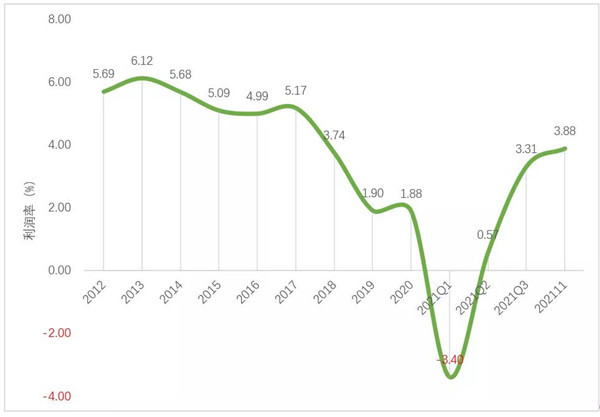
The overall revenue of the industry grew steadily, and the profitability recovered significantly. From January to November, the operating income of wool textile enterprises above designated size increased by 8.7 year-on-year. The average profit margin of wool textile enterprises was close to 4%, up 2 percentage points year on year.
The degree of intensification of the industry is increasing. In the first three quarters of 2021, the operating income of six listed companies in the wool textile industry increased by 47.7 year-on-year, with an average profit level of more than 20%. The market value growth rate of wool textile listed enterprises will lead the textile sector in 2021, and the market recognition of industrial value will be further enhanced.
Average Profit Margin of Wool Textile Industry from 2012 to 2021
III. Analysis and Prospect in 2022
In 2021, the global epidemic and macro-policy changes, the impact of the political landscape persists, and the trend of trade globalization and liberalization fluctuates forward, making the industry show a "high before low" trend, but still achieved good results. In 2022, there will still be many uncertainties in the wool textile industry.
1, the domestic demand market will be the focus of the wool textile industry in the medium and long-term development momentum. The proportion of the domestic consumer market in the wool textile product market continues to increase, and the industry needs to actively tap the demand space for wool textile products in various products and consumer markets at all levels. The rise of domestic brands and national tide culture brings opportunities for the development of domestic demand for wool spinning.
There are still many uncertainties in international markets and macroeconomic policies. According to the International Monetary Fund (IMF), the global economy will grow at 5.9 per cent in 2021 and 4.9 per cent in 2022. Due to the difference in national financial support and vaccination rates, the economic recovery of developed countries will be better than that of developing countries. The traditional consumption market of wool spinning is dominated by major developed countries, and the recovery of wool spinning consumption is expected to continue in 2022.
3. The industrial structure and layout are facing new challenges. In recent years, the international wool textile industry has developed a new geographical layout. Many old wool textile countries have begun to invest in Southeast Asia and other places to set up wool textile primary processing and wool textile factories. These regions will gradually become competitors in the wool textile processing supply chain.
4. The upgrading and transformation of the industry itself will be an important core for the development of the industry and enterprises. The degree of recovery of all links in the industrial chain is uneven, the price transmission mechanism is not smooth, and wool textile processing and manufacturing are facing greater cost pressure. The differentiation of enterprise development is becoming more and more obvious. Enterprises that can seize the trend of the times, integrate into the new development model, and constantly upgrade and self-change can seize the opportunity and achieve development.
(Source: China Wool Textile Industry Association)
More information

Follow us
Hello, what can we do for you?
Copyright © Xiantao Dexing Plastic Products Co., Ltd / Xiantao Dexing Health Technology Co., Ltd | Powered by:300.cn
SAF Coolest v1.3.1.2 设置面板 FZUSD-ZSNG-OSSQE-ZWE
无数据提示
Sorry, the current column is being updated, please look forward to it!
You can view other columns or returnHome Page