


News Center
News Center
In the fourth quarter of 2021, the textile industry boom rose.
Release time:
2022-02-12
In January 2022, the China Textile Industry Federation carried out a survey on the current situation of textile business managers. After the collation and analysis of valid data, the textile business climate index increased in the fourth quarter of 2021 compared with the third quarter, and the industry is very cautious about the expected judgment of the first quarter of 2022.
In January 2022, the China Textile Industry Federation carried out a survey on the current situation of textile business managers. After the collation and analysis of valid data, the textile business climate index increased in the fourth quarter of 2021 compared with the third quarter, and the industry is very cautious about the expected judgment of the first quarter of 2022.
Overall boom up
According to calculations, the prosperity index of my country's textile industry in the fourth quarter of 2021 was 62.3, an increase of 3.6 points from the third quarter. The main reason is that the domestic epidemic situation is better controlled, the National Day holiday, the "Double Eleven" e-commerce promotion, and the promotion of Chinese New Year commodities. Factors such as the continuous recovery of the consumer market and the strong resilience and vitality of textile industry enterprises, my country's textile industry recovered steadily in the fourth quarter. This is also in line with the National Bureau of Statistics on the development trend of the manufacturing purchasing manager index. After withdrawing from the expansion range for two consecutive months in September and October, the manufacturing PMI returned to the expansion range in November and December, and the index was 50.3 in December.%.
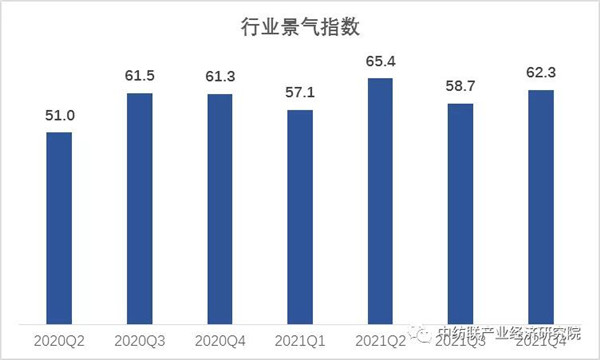
Data source: China Textile Industry Federation Industrial Economic Research Institute.
In the fourth quarter of 2021, the profitability of China's textile industry increased compared with the third quarter. According to the survey, 46.6 percent of textile enterprises said that their profits in the fourth quarter were higher than those in the third quarter, which was 7.7 percentage points higher than that in the third quarter. 22.1 percent of textile enterprises said that their profits were lower than that in the third quarter, which was 7.1 percentage points lower than that in the third quarter.
Increased production activity
It is estimated that the production index of the textile industry in the fourth quarter of 2021 was 69.1, up 6.9 points from the production index in the third quarter, and the overall activity of production was improved.

Data source: China Textile Industry Federation Industrial Economic Research Institute.
Affected by the high base after the low value added of the textile industry last year, the growth rate of the industry's value added this year showed a trend of high and low. According to data from the National Bureau of Statistics, from January to December 2021, the industrial added value of my country's textile industry increased by 4.4 year-on-year, which was 1.9 percentage points lower than the growth rate from January to September. But on the whole, the output of China's main textile products has maintained different growth rates. According to the National Bureau of Statistics, in 2021, chemical fiber will grow 9.1 percent year-on-year, yarn will grow 8.4 percent year-on-year, cloth will grow 7.5 percent year-on-year, and clothing will grow 8.4 percent year-on-year.
consumption growth accelerates
It is estimated that the new order index of China's textile industry in the fourth quarter of 2021 was 66.8, 5.3 points faster than the third quarter, and the market demand is in the growth range. The main reason is that my country's economy has recovered steadily and the consumer market has continued to recover; the international market demand has rebounded, which has driven the growth trend of new orders.
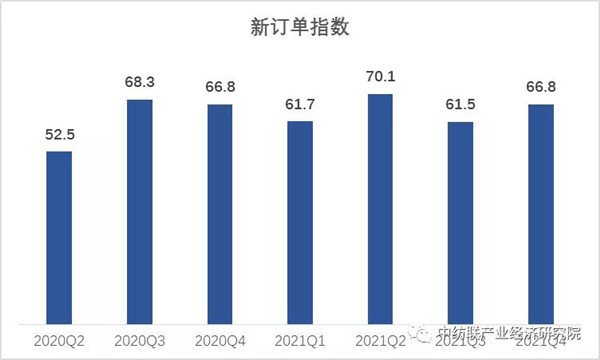
Data source: China Textile Industry Federation Industrial Economic Research Institute.
Domestic online and offline consumer market sales are good, the internal cycle is smooth. According to data from the National Bureau of Statistics, in 2021, my country's retail sales of clothing, shoes, hats, needles, and textiles were 1384.2 billion yuan, an increase of 12.7 percent year-on-year, and online clothing retail sales increased by 8.3 percent year-on-year.
Orders in the international market increased slightly, and exports hit a record. It is estimated that in the fourth quarter of 2021, the international order index of China's textile industry was 52.5, and new orders increased slightly compared with the third quarter. According to China's customs data, in 2021, China's textile and clothing exports of 315.47 billion billion U.S. dollars, an increase of 8.4 percent over the same period last year, of which textile exports of 145.2 billion billion U.S. dollars, down 5.6 percent year-on-year; clothing exports of 170.26 billion billion U.S. dollars, an increase of 24.0 percent over the same period last year; exports hit a record high in the same period.
High raw material prices fall
According to estimates, in the fourth quarter of 2021, China's textile industry raw material purchase price index 77.4, down 3.2 percentage points from the previous price index. Raw material prices in the continued high operation, to the textile downstream conduction resistance, to the fourth quarter of the lack of support after the price began to fall.
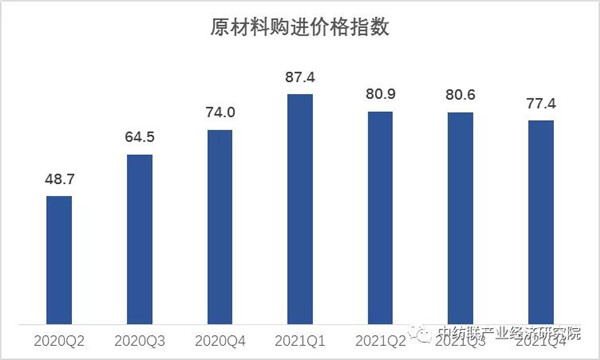
Data source: China Textile Industry Federation Industrial Economic Research Institute.
According to market tracking data, driven by demand, the market price of raw materials continued to rise in 2021, especially in early October, there was a wave of rapid rise. However, by the end of October, affected by a series of national regulatory measures and the Federal Reserve's easing policy, the price transmission to the downstream was blocked, and the price of textile raw materials began to turn down. In December, the average domestic cotton price remained at 21970 yuan/ton, slightly higher than the average cotton price in October, 2.4 percent; polyester staple fiber prices to 6908 yuan/ton, down 13.3 percent from October; but viscose staple fiber prices fell back to 12626 yuan/ton, down 10.2 percent from October. Overall, textile raw material prices fell in November and December.
According to the survey, most enterprises purchase raw materials on demand or only 30 days in advance when ordering raw materials. Due to avoiding the influence of purchase price fluctuation, enterprises seldom purchase more than 90 days in advance. In the survey, less than 20% of enterprises purchase raw materials more than 90 days in advance.
Industry investment remains stable
In the fourth quarter of 2021, China's textile industry as a whole maintained a relatively stable investment rhythm. According to the survey, 46.9 per cent of enterprises said their investment remained stable this year, while 35.0 per cent said their investment increased this year, an increase of 2.1 percentage points over the previous survey. According to the National Bureau of Statistics, in 2021, China's textile industry, textile and clothing industry and chemical fiber industry fixed asset investment increased by 11.9, 4.1 and 31.8, respectively. Although on the whole, the growth rate of fixed asset investment in the textile industry has slowed down this year, the growth rate of fixed asset investment in the chemical fiber industry has exceeded the average growth rate of the manufacturing industry since July, and the annual growth rate has been higher than that of the manufacturing industry by 18.3 percentage points; the growth rate of the textile industry has also been approaching the average investment growth level of the manufacturing industry.
In the survey of new fixed asset investment projects, although enterprises invest more in upgrading their original capacity in 2021, 58.1 per cent of enterprises are upgrading and transforming on the basis of their original capacity, which is the main new fixed asset investment project for enterprises at present; but 28.8 per cent of the sample enterprises have still carried out new capacity. According to enterprise feedback, the main factors affecting enterprise investment are the market prospects and enterprise benefits of the industry. 72.2 per cent of enterprises said that market prospects were an important factor affecting their investment, and 65.3 per cent said that business efficiency was an important factor affecting their investment.
Be cautious about future development
Based on their own production and operation status and their feelings about the market, the survey enterprises make an outlook for the industry in the first quarter of 2022. On the whole, enterprises are more cautious about the future business climate. According to estimates, the textile industry boom index is expected to be 51.2 in the first quarter of 2022, down 11.1 points from the industry boom index in the fourth quarter of 2021, and enterprises believe that the overall speed of operation in the first quarter of 2022 will slow down compared with the fourth quarter. Specifically, it is expected that in the first quarter of 2022, production may slow down; new orders may decrease slightly; and raw material prices may continue to fall at high levels.

Data source: China Textile Industry Federation Industrial Economic Research Institute.
(Source: China Textile Industry Economic Research Institute)
More information

Follow us
Hello, what can we do for you?
Copyright © Xiantao Dexing Plastic Products Co., Ltd / Xiantao Dexing Health Technology Co., Ltd | Powered by:300.cn
SAF Coolest v1.3.1.2 设置面板 FZUSD-ZSNG-OSSQE-ZWE
无数据提示
Sorry, the current column is being updated, please look forward to it!
You can view other columns or returnHome Page