


News Center
News Center
Innovation and development lead the sustainable road of China's nonwovens industry
Release time:
2023-12-21
Nonwovens are an important part of the textile industry, and their development is facing challenges from traditional social responsibility fields such as the environment, supply chain, and society. As the core raw material in the fields of medical and health, environmental protection, geotechnical construction, transportation, etc., nonwovens have made important contributions to the innovative development and energy conservation and emission reduction in these fields, and enriched the connotation of social responsibility in the nonwovens industry.
Nonwovens are an important part of the textile industry, and their development is facing challenges from traditional social responsibility fields such as the environment, supply chain, and society. As the core raw material in the fields of medical and health, environmental protection, geotechnical construction, transportation, etc., nonwovens have made important contributions to the innovative development and energy conservation and emission reduction in these fields, and enriched the connotation of social responsibility in the nonwovens industry.
China's nonwovens industry is still in an active period of technological innovation, rapid industrial development and application field expansion. Under China's current social and economic conditions, the social responsibility of the industry mainly comes from two aspects. One is the consumption of non-renewable resources and environmental problems caused by the large-scale use of disposable nonwovens, The other is how the industry can create greater social and economic value for the society and other sectors of the national economy through technological innovation.
China's nonwovens industry regards innovation and development as the key to solving the social responsibility problems it faces, and has gradually clarified and formed an industry social responsibility strategy: strengthen dialogue and collaboration with industry chain stakeholders, and promote industrial innovation by leading industry technological innovation, Promote application innovation, promote stable growth and sustainable development of the industry, create value and share value.
Social Responsibility Strategy of Nonwovens Industry
Referring to the CSC9000T of the social responsibility management system of textile and garment enterprises, combined with the characteristics of social responsibility and sustainable development of the nonwovens industry, China's nonwovens industry has identified industrial development responsibility, supply chain responsibility, environmental responsibility and human responsibility as the four dimensions of industry social responsibility, and determined the objectives and behavior norms of social responsibility under this framework.
1. Industrial development responsibility: Through innovation and market expansion, ensure the stable growth of the scale and efficiency of the nonwovens industry, improve the ability of the industry to serve various sectors of the national economy, provide more jobs for the society, and prosper the local economy.
2. Supply chain responsibility: promote the application of green environmental protection raw materials, establish a green supply chain system for the nonwovens industry, promote cooperation and dialogue among relevant parties in the supply chain, and maintain a good industry order.
3. Environmental responsibility: the application of new materials and new technologies to reduce the impact of industrial development and product application on the environment, save resource consumption, and reduce the emission of greenhouse gases and other harmful substances.
4. Humanism: people-oriented, pay attention to the growth and development of employees, protect the rights and interests of consumers, give back to the society through various forms, and realize the harmonious development of industry, people and society.
industrial development responsibility
The China Industrial Textiles Industry Association supports the nonwovens industry to strengthen industrial basic capability innovation, core common technology innovation, and high-end application technology innovation, supports the industry to strengthen the training of high-level talents and professional and technical personnel, encourages enterprises to increase the proportion of R & D investment, and promotes the two In-depth integration and intelligent manufacturing; strengthen the coordination of the industrial chain, expand the application fields of nonwovens, and provide high-quality products; we will support industrial clusters to expand their industrial scale, cultivate and develop new kinetic energy and new business forms around core industries, and actively promote the construction of world-class industrial clusters.
1. Industrial scale
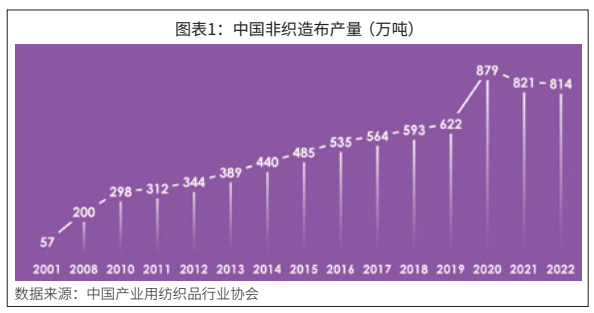
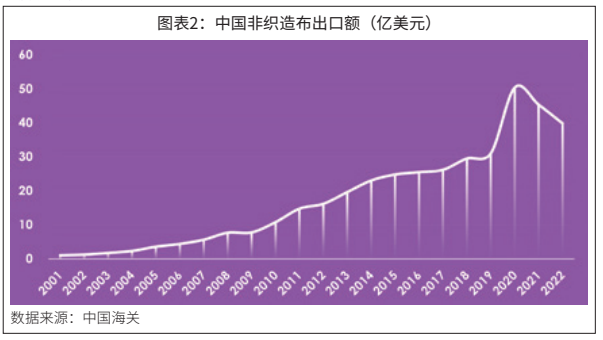
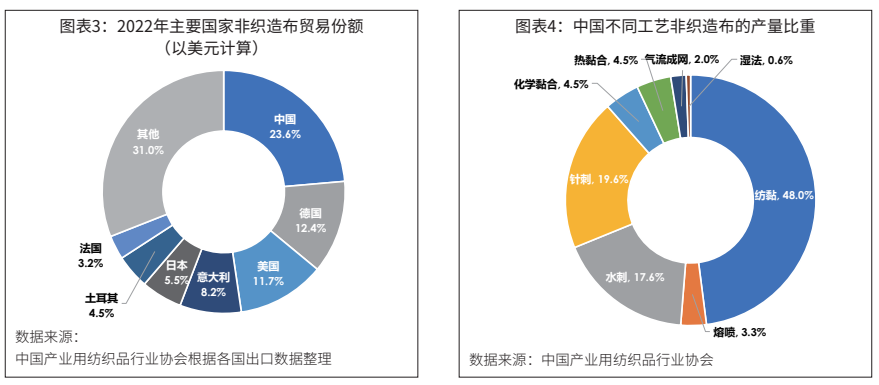
In 2001, China's nonwovens output was only 569000 tons, increasing to 8.788 million tons in 2022, and the average annual growth rate of China's nonwovens output reached 13.9 in 21 years. From 2001 to 2022, China's nonwovens export volume increased from 43000 tons to 1.208 million tons, and the export volume increased from 0.11 billion US dollars to 3.99 billion US dollars, with an average annual growth rate of 17.2 and 18.6 respectively. Its share in global trade increased from 2.4 to 23.6 in 2022. In 2022, there will be about 1500 non-woven coil enterprises above designated size in China, of which 10 enterprises will have annual sales of more than 1 billion yuan.
2. Industrial innovation
The investment intensity of nonwovens is high, the technology content is relatively high, the industry attaches great importance to technological innovation and product development, the localization of raw materials and equipment, the development and application of high-performance products and other aspects have achieved fruitful results. China has been able to produce spunbond, meltblown, spunlace, needle punching and other major non-woven equipment, the main performance indicators of the equipment and the international advanced level of the gap continues to narrow, is currently expanding in the field of intelligence, the research and development of domestic equipment has greatly reduced the investment threshold of the industry, and promoted the rapid development of the industry. In terms of product development, high-performance spun-melt nonwovens, spunlace nonwovens, hot air nonwovens, geotextiles, tire base fabrics, and filter materials have replaced traditional materials in a large area, promoting medical, health, environment, and construction. Technological progress, quality improvement, energy saving and emission reduction in engineering and other fields.
In 2022, the R & D expenses of China's nonwovens industry accounted for 3.44 percent of operating income. Up to now, more than 1600 patents have been obtained, and many projects have won various technical awards. Donghua University and other 5 units jointly completed the "high curvature liquid surface electrostatic spinning non-woven material macro preparation key technology and industrialization" project won the second prize of 2020 national technology invention; dalian Huayang Encyclopedia's "Production Method of Two-Component Spunbond Hot Air Solidified Nonwovens", Fujian Hengan's "A Nonwovens and Manufacturing Method", Shandong Lupu Technology's "Slip Rope and Preparation Method for Aviation Fire Fighting" three patents won the 23rd China Patent Excellence Award in 2021.
Supply Chain Responsibility
The goal of supply chain responsibility is to establish a safe, stable and green supply chain system for the nonwovens industry. The focus is on the development and application of environmentally friendly fiber raw materials, to promote nonwovens companies to meet the user's sustainable development criteria, and to build a fair and reasonable industry chain between enterprises. The competition and cooperation relationship promotes dialogue and collaboration between upstream and downstream industries.
China Industrial Textiles Industry Association advocates increasing the application proportion of biomass fibers such as cotton, hemp, viscose, polylactic acid, chitosan and seaweed in disposable products such as sanitary products, wiping materials, medical dressings and packaging materials, and agricultural textiles, so as to promote green consumption. Increase the proportion of recycled fiber applications in geotechnical construction, transportation, agriculture and other fields. Carry out the standard construction, tag identification, certification and promotion of green nonwoven products, and increase the proportion of green nonwoven products; enterprises in the supply chain abide by national laws and regulations, respect intellectual property rights, fair competition, and abide by business ethics to jointly maintain a good market order and industry image.
1. Chemical fiber
Chemical fibers (including slices) are the main raw materials for non-woven fabrics, and cotton, hemp fibers, silk and wood pulp have a small amount of applications in non-woven fabrics. The proportion of sliced raw materials in all raw materials exceeds that of short fibers, with slices accounting for 51% and short fibers accounting for 49%. Sliced raw materials are mainly used to produce spunbond and meltblown nonwovens.
The main raw material of spun-laid nonwovens is polypropylene chips, accounting for 86% of the total chips. Polypropylene spunbonded nonwovens are mainly used in sanitary materials, medical treatment and packaging, which are the key application fields of nonwovens. Due to the rapid growth of polyester spunbonded tire base cloth, the application amount of polyester in spunbonded products has been significantly increased, accounting for 18.2 in 2022. There are also a few domestic companies that have broken through the spunbond technology of polylactic acid and polyphenylene sulfide, but the output is relatively low. In addition, polyethylene has a small amount of application in spinning nonwoven fabrics.
Among the staple fibers, polyester and polypropylene are the most widely used fiber varieties, accounting for 54% and 20% of the total respectively. Polyester is widely used in nonwovens, such as spunlaced nonwovens, geotextiles, automobile carpets, etc. Polypropylene staple fiber is mainly used in geotextiles, carpets, sanitary materials, etc. The proportion of viscose in nonwovens is about 4%, which is mainly used in spunlaced nonwovens. Glass fiber is widely used in filtration, geotechnical and insulation and isolation fields. High-performance fibers such as aramid, polyimide, polyphenylene sulfide, and polytetrafluoroethylene are mainly used for high-temperature filtration and insulation materials, with a dosage of no more than 50000 tons, and their proportion in the total amount of non-woven fabrics is not high.
2, Cotton
The amount of cotton in nonwovens is relatively low, but with the development and promotion of cotton spunlace nonwovens and their products in China, the application of cotton in the spunlace nonwovens industry is increasing. Cotton spunlace nonwoven fabric is a product with technical advantages and large-scale application in China. It is mainly used for wiping (cotton soft towel) and cosmetic cotton, creating a brand-new high-grade product category. With the continuous progress of industry technology, the performance of cotton spunlace nonwoven fabric has been steadily improved, and its application is expanding to the surface materials of diaper pants and sanitary napkins, medical dressings and other fields.
The growth and development of cotton spunlaced nonwovens has adapted to the trend of China's economic growth, consumption upgrading and consumer awareness of environmental protection. Cotton spunlace nonwovens are more skin-friendly, environmentally friendly and comfortable, and bring better consumer experience to users; compared with woven gauze, nonwovens have higher production efficiency, better performance and lower cost. In the future, the market space of cotton spunlaced nonwovens is very large, and the production capacity and output will continue to maintain a high growth rate of more than 10%.
3. Cellulose fiber
Cellulose fiber mainly includes viscose fiber, acetate fiber, copper ammonia fiber, etc., is the use of cotton linters, wood, bamboo, bagasse, reed and other natural substances, through a certain process treatment method of its cellulose molecular remodeling, with natural, comfortable, biodegradable, renewable, environmental protection and other characteristics. China is a big producer of cellulose fiber, with an output of 3.994 million tons in 2022.
In the nonwovens industry, cellulose fiber is mainly used in the field of spunlaced nonwovens, and it is also an area where the amount of cellulose fiber is growing faster. In 2022, the application proportion of cellulose fiber in China's spunlaced nonwovens industry was about 33%, an increase of nearly 5 percentage points compared with 2015. At present, the proportion of cellulose fiber in domestic spunlaced nonwovens is 30% ~ 40%, while the proportion of export products is more than 60%. With the decline in the price of cellulose fiber, the strengthening of green consumption awareness, and the popularity of wet wipes, soft wipes and other products in the domestic market, there is still a lot of room for improvement in the application of cellulose fiber in China's spunlaced nonwovens industry in the future. It is expected to reach 55% in 2025.
4. Polylactic acid
Polylactic acid (PLA), also known as polylactide, lactic acid as monomer, dehydration polymerization. It uses corn, cassava, straw and other renewable biomass as raw materials, and has a wide range of sources and renewable. After the use of polylactic acid products can be composted into CO2 and water, to achieve the cycle in nature. As of 2022, the global production capacity of polylactic acid is about 625000 tons, and the fiber production capacity is about 120000 tons.
Challenges and Future Prospects
As an emerging industry in the textile industry, my country's non-woven fabric industry has developed vigorously. It has achieved remarkable results in terms of industrial scale, innovation capabilities, application expansion, and social responsibility, and has made due contributions to economic and social development and progress. Contribution, especially in the battle to prevent and control the new coronary pneumonia epidemic, the industrial status and effective work of non-woven fabrics have been recognized by the government, society and the public, there are also higher expectations and demands.
In the new era, the development of China's nonwovens industry is facing many challenges. First of all, nonwovens are a technology-intensive and globally competitive industry. Compared with developed countries, my country still has shortcomings and shortcomings in key technologies, production equipment, high-performance raw materials and high-end applications, which restrict industrial upgrading and key areas. Application. Secondly, the extensive use of nonwovens and disposable products has caused certain pressure on the environment and has gradually become a concern of the global industry. The industry needs more environmentally friendly solutions to echo the global green development trend. Third, the production process of the nonwovens industry is facing greater pressure on energy conservation and emission reduction, reducing resource consumption and waste emissions in the entire industrial chain, and building a green supply chain system. Fourth, the global industrial layout situation and trade pattern changes, so that China's nonwovens industry is facing more international competition.
The "14th Five-Year Plan" period is the historical intersection of my country's "two centenary" goals, and it is also an important period of opportunity to fully open a new journey of building a modern socialist power. China's nonwovens industry is also in a critical period of structural adjustment and industrial upgrading. The traditional advantages of demographic dividend and factor resources are weakening, and new advantages such as science and technology, talents, management, capital and brand are being generated, which has become an important driving force for the sustainable development of the industry.
In the face of the complicated domestic and international environment and the changing nonwovens market, China's nonwovens industry will continue to adhere to innovation and lead, and continue to actively promote supply-side reform. In terms of raw materials, it promotes the application of natural fibers, bio-based fibers, recycled fibers and other high-functional fibers to give non-woven products new functions and characteristics. In the manufacturing process, actively promote intelligent manufacturing and green manufacturing, increase the application of advanced equipment and software systems in the production process, improve product quality, reduce energy consumption and emissions, and enhance the ability of enterprise fine management. In terms of scientific and technological innovation, we should strengthen the training of high-level talents and the construction of R & D platform, and focus on the R & D and application of key common technologies and key products in the industry. In terms of market applications, actively respond to the general trend of consumption upgrades, improve product quality and grades, and promote the in-depth application of non-woven fabrics in the fields of medical disease control, air and liquid purification, transportation, and geotechnical construction. In terms of foreign investment, enterprises with conditions are encouraged to "go global" for direct investment, carry out international production capacity cooperation through strategies such as "One Belt and One Road", and expand the global layout of China's nonwovens industry. In the future, China's nonwovens will usher in better development and assume greater responsibility for the country and society!
Excerpts from the "2021-2023 China Nonwovens Industry Social Responsibility Report" jointly issued by the Social Responsibility Office of China Textile Industry Federation, China Industrial Textiles Industry Association, and Sedley. The original report can be downloaded from the official website of the China Industrial Textiles Industry Association (www.cnita.org.cn).
Source: Jung-International Nonwoven Industry Business
Previous article
More information

Follow us
Hello, what can we do for you?
Copyright © Xiantao Dexing Plastic Products Co., Ltd / Xiantao Dexing Health Technology Co., Ltd | Powered by:300.cn
SAF Coolest v1.3.1.2 设置面板 FZUSD-ZSNG-OSSQE-ZWE
无数据提示
Sorry, the current column is being updated, please look forward to it!
You can view other columns or returnHome Page