


News Center
News Center
Operation Analysis of China's Industrial Textile Industry in the First Half of 2023
Release time:
2023-10-07
In the long run, the fundamentals of the industry have not changed. Enterprises are cautiously optimistic about their future expectations and are still willing to invest in advanced production capacity, digitalization and green development. In the second half of 2023, with the implementation of the country's positive policies and the weakening of the epidemic disturbance factors, the industry situation is expected to improve, the decline in the main economic indicators will be narrowed, but will not change the low operating situation.
In the first half of 2023, the global economy was in a fragile recovery. Although the growth prospects have improved, it still faces a high degree of uncertainty; the domestic economy has rebounded, but the foundation for sustained economic recovery is still not solid. China's industrial textile industry continues to be in the adjustment period after the outbreak of epidemic prevention materials demand growth and then decline, the release of large investment in production capacity impact supply and demand system, competition in related fields intensified; other areas outside the epidemic prevention materials industry chain still maintained a more stable development.
Since the outbreak of the epidemic in 2020, the industrial value added of China's industrial textiles industry has fluctuated significantly. The growth rate of industrial value added in the industry reached an all-time high in 2020, fell back rapidly in 2021, began to resume growth after 2022, reached the highest point of the year in the first half of 2022, and then began to slow down, entering the downward range again since 2023 (Figure 1).
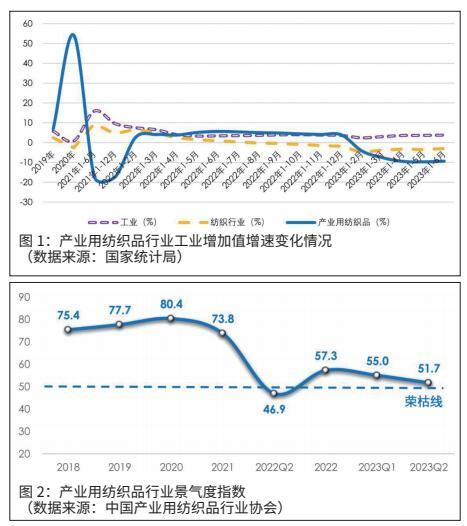
According to the Association's survey of sample enterprises, the prosperity index of the industrial textiles industry in the first half of 2023 was 51.7, in the micro-boom range, down 3.3 from the first quarter of 2023, up 4.8 from the same period in 2022, and well below the pre-2021 indicator (Figure 2).
Market Demand and Production
According to the Association's survey of member companies, 45.9 and 39.2 percent of the surveyed companies said that the demand in the domestic and international markets had declined to varying degrees in the first half of 2023 (Figure 3), and the domestic and international market demand indexes were 37.8 and 46.1 respectively, down 5.1 and 3.9 respectively compared with the first quarter (42.9 and 50.0). In terms of different fields, the domestic demand market of textiles for transportation and structural enhancement has continued to recover, and the domestic market demand index is above the boom and bust line; in terms of international orders, the international market demand index of nonwovens, safety and protective textiles, and filtration and separation textiles is above the boom and bust line, and the demand for nonwovens in overseas markets is obviously warmer than that in the first quarter.


In terms of orders on hand, 32.2 per cent of respondents had a relatively stable and continuous source of orders or orders on hand could support production for more than three months, while 28.3 per cent of respondents had orders on hand to support production for less than one month. According to the size of the enterprise, the orders in hand of large enterprises are more stable and sufficient, and can support longer production, while the orders in hand of small and medium-sized enterprises can only support production within one month or even half a month (Figure 4). Despite the decline in market demand, the industry's capacity utilization rate remained stable. According to the research of the association, the average capacity utilization rate of the industry in the first half of 2023 reached 71.7, an increase of 0.7 percentage points from the first quarter, of which the proportion of enterprises with capacity utilization rate of more than 70% increased by 3.8 percentage points from the first quarter.
According to the data of the National Bureau of Statistics, from January to June 2023, the output of non-woven fabrics of enterprises above designated size decreased by 2.2 year-on-year, and the decline continued to narrow after the first quarter; the output of cord fabric increased by 2.8 year-on-year, reversing the long-term downward trend.
economic benefit
According to data from the National Bureau of Statistics, from January to June 2023, the operating income and total profits of enterprises above designated size in the textile industry decreased by 7.6 and 41.5 respectively, and the profit margin was 2.9, down 1.7 percentage points from the same period last year. From January to June, the operating income and total profits of non-woven enterprises above designated size decreased by 5% and 66% respectively compared with the same period last year, but the profit margin was only 1.2, down 2.2 percentage points from the same period last year, which is at the lowest level in history. The operating income and total profits of enterprises above designated size of other industrial textiles where filtration and geotechnical textiles are located decreased by 9.6 and 19.6 respectively compared with the same period last year, however, the gross profit margin increased by 1.44 percentage points to 17.6 per cent, the highest level in the industry, and the profit margin remained above 5 per cent to 5.2 per cent (Table 1).

According to the survey conducted by the association, 30% of the enterprises said that their income had increased to varying degrees in the first half of the year, 23% of the enterprises said that their profits had increased, and 30% and 26% of the enterprises said that their income and profits were basically the same. Since 2023, the industry's profitability has declined sharply, mainly due to increased competition in the market leading to the continued decline in finished product prices, the association's research shows that the industry's first half of the finished product price index is only 32.6, compared to the end of 2022 and the first quarter of 2023, respectively, down 6.1 and 12.0.
international trade
According to China's customs data, the export volume of China's industrial textile industry from January to June 2023 (customs 8-digit HS code statistics) was 20.07 billion US dollars, down 12.5 percent from the same period last year, and the decline deepened. Industry imports from January to June (customs 8-digit HS code statistics) were 2.6 billion US dollars, down 17.3 percent from the same period last year. In the first half of 2023, the export of key products of the industry (Chapter 56 and 59) to major trading partners decreased to varying degrees, but the export to Russia increased by 50.1. Asia is the largest export market of China's industrial textiles, and the United States is still the second largest single export market of China's industrial textiles.
In terms of major export products, felt/tents, industrial coated fabrics and nonwovens are the top three export products in the industry, with exports falling by 12.7 per cent, 8.8 per cent and 5.4 per cent respectively compared with the same period last year, but in terms of quantity, 622000 tons of nonwovens were exported, an increase of 1.9 per cent, while exports of diapers and sanitary napkins reached US $1.66 billion per cent, an increase of 21.7 per cent over the same period last year; the decline in exports of cord (cable) belt textiles, leather-based fabrics, industrial glass fiber products, and packaging textiles has deepened to varying degrees (Table 2).
Despite the decline in overall exports, exports of some high-tech market segments maintained a relatively high growth rate, such as airbag exports of US $0.43 billion, an increase of 14.2 percent over the same period last year; industrial felt exports of US $0.21 billion, an increase of 8.3 percent over the same period last year; structural enhancement textiles of US $0.11 billion, an increase of 6.5 percent over the same period last year; and filtration and separation textiles of US $0.11 billion, 13.2 percent year-on-year (Table 3). These reflect the positive results achieved by the industry in technological innovation, product development and market expansion in recent years.
Annual Development Forecast
At present, the operating indicators of China's industrial textiles industry are at a historical low. The demand for epidemic prevention materials such as masks and protective clothing has fallen off a cliff, driving the production, domestic and foreign sales and profits of the entire industrial chain to fall sharply. At the same time, the rapid expansion of nonwoven production capacity has had a great impact on the smooth operation of the industry. The impact of these factors is gradually weakening; although the fields related to non-epidemic prevention materials are facing some general difficulties, the quality and efficiency of operation are still in a relatively reasonable range.
In the long run, the fundamentals of the industry have not changed. Enterprises are cautiously optimistic about their future expectations and are still willing to invest in advanced production capacity, digitalization and green development. In the second half of 2023, with the implementation of the country's positive policies and the weakening of the epidemic disturbance factors, the industry situation is expected to improve, the decline in the main economic indicators will be narrowed, but will not change the low operating situation.
Source: China Industrial Textile Industry Association
Source: Jung-International Nonwoven Industry Business
More information


Follow us
Hello, what can we do for you?
Copyright © Xiantao Dexing Plastic Products Co., Ltd / Xiantao Dexing Health Technology Co., Ltd | Powered by:300.cn
SAF Coolest v1.3.1.2 设置面板 FZUSD-ZSNG-OSSQE-ZWE
无数据提示
Sorry, the current column is being updated, please look forward to it!
You can view other columns or returnHome Page