


News Center
News Center
"Technical specification for children's masks" national standard officially released
Release time:
2020-05-09
On May 6, 2020, the General Administration of Market Supervision (Standards Committee) officially released the GB/T 38880-2020 "Technical Specification for Children's Masks" recommended national standard, which will be implemented as soon as it is released.
On May 6, 2020, the General Administration of Market Supervision (Standards Committee) officially released the GB/T 38880-2020 "Technical Specification for Children's Masks" recommended national standard, which will be implemented as soon as it is released.
In 2016, China issued the recommended national standard GB/T 32610-2016 "Technical Specification for Daily Protective Masks", which provides a good standard for adult daily protective masks, but this standard does not apply to children's masks. Children are in a critical period of growth and development, need to focus on protection, the current market for the nominal children's masks of a wide variety of products, the quality of good and bad, market supervision without a standard, causing people's concern, school-age children back to school, parents how to choose the right mask for them and other issues have become the focus of social concern.
The national recommended standard of "Technical Specification for Children's Masks" released this time is my country's first national standard for children's masks led by the China Industrial Textile Industry Association (hereinafter referred to as "China Industry Association"). It provides a basis for the correct selection and wearing of children's masks, standardizing the order of industry competition, and strengthening market supervision, It provides technical support and standard guarantee for children's mask manufacturers.
1, "children's mask technical specification" development process.
Since 2018, on the basis of preliminary project establishment, investigation and standard research, and in combination with the existing industrial situation, the China Industry Association has joined forces with Beijing Institute of Labor Protection Science, Beijing Institute of Medical device Inspection, China Institute of Standardization, Children's Hospital of Capital Institute of Pediatrics, Guangzhou Inspection and Certification Group Co., Ltd., Guangzhou Customs Technology Center, Donghua University, mask and mask material backbone enterprises and other units and scientific research institutes, organize experts in personal protection, medical and health, ergonomics, textile materials, testing and other aspects to carry out a large number of studies on the physiological characteristics of children of different ages, such as head and face size, respiratory system, etc., and carry out a large number of data collection, comparative analysis of mask materials, structure and performance, and design a mask index system and test method in line with the characteristics of children.
In early 2020, with the outbreak of the new crown epidemic, in order to meet the urgent needs of children to travel and resume school as soon as possible, the standard preparation team, in accordance with the requirements of the General Administration of Market Supervision (Standards Committee), urgently accelerated the preparation process, enriched and improved the standard framework system, completed the draft for comments, and publicly solicited comments from the whole society. A total of 240 replies were received, and the draft for comments attracted widespread attention and participation from the society. The standard preparation team processed the comments, revised the standard text, and completed the draft standard for approval on March 31, 2020. In the process of standard approval, the preparation team further revised it according to the expert opinions of relevant departments, and finally completed the approval work on April 13.
2. Classification of children's masks
The Technical Specification for Children's Masks applies to masks worn by children aged 6 years and older to 14 years and younger. Children's masks are divided into "child protective masks (F)" and "child hygiene masks (W)" according to performance ".
Children's protective masks are mainly three-dimensional, with good adhesion, which can prevent microorganisms, droplets, dust, pollen and other particulate matter inhalation. It can be used in moderately polluted or potentially medium-risk environments, such as stations, public transportation, airports, supermarkets and other scenarios during haze days, high influenza season and large (level III) public health emergencies.
Children's health masks are mainly flat, with good comfort, which can block the spread of microorganisms, droplets, dust, pollen and other particles. It can be used in low-pollution or low-risk environment, such as restaurants, classrooms, workplaces, dormitories and other scenes during daily cold, flu, pollen season and general (level IV) public health events.
It is recommended not to wear a mask in the scene of home, outdoor, no gathering of people and good ventilation. Children's masks are divided into small (S), medium (M) and large (L) according to the size of children's head and face.
3. Main requirements for children's masks
The Technical Specification for Children's Masks specifies the basic requirements, appearance quality and test methods of masks, and puts forward 19 main performance indicators, including safety, protection and comfort, with safety as the premise and protection and comfort as the goal.
Safety performance:
The mask should be able to cover the mouth, nose and jaw safely and firmly, without peculiar smell. The mask will not be damaged or deformed during the normal service life. The field of vision shall not be significantly affected.
The raw materials of masks shall not use recycled materials, materials known to cause skin irritation or other adverse reactions, chlorine bleaching treatment, mobile fluorescent whitening substances shall not be detected, formaldehyde content of masks ≤ 20 mg/kg, ethylene oxide residue ≤ 2 μg/g, and residues of other restricted substances shall meet relevant requirements.
The mask shall not detect coliform bacteria and pathogenic pyogenic bacteria, the total number of fungal colonies ≤ 100CFU/g, the total number of bacterial colonies ≤ 200CFU/g.
For masks equipped with breathing valves, the breathing valves shall not slip, break and deform, and the internal parts shall not fall off during normal use.
Masks should not use lace-up mask straps. The breaking strength of the mask band and its connection with the mask body of the child protective mask shall be ≥ 15N, and the breaking strength of the mask band and its connection with the mask body of the child hygiene mask shall be ≥ 10N.
For masks equipped with nose clips, the length of the nose clip is required to be ≥ 5.5cm, and it should not be broken when folded in half for 20 times.
The inner material of the mask in direct contact with the skin (including the mask tape) should not be printed or dyed (including stock solution coloring), and the pH value is 4.0~7.5. The color fastness of the outer layer of the mask with printing or dyeing to dry rubbing is ≥ 4, and the mask is prohibited from decomposing carcinogenic aromatic ammonia dyes.
The mask should have a certain degree of flame retardant performance, there should be no exposed metal and can reach the sharp tip and sharp edge.
Protection performance:
Children's protective masks require particle filtration efficiency of not less than 95% and protective effect of not less than 90%;
Children's health masks require particle filtration efficiency of not less than 90% and bacterial filtration efficiency of not less than 95%.
Comfort performance:
Child protective masks require inspiratory resistance not higher than 45Pa, expiratory resistance not higher than 45Pa;
Children's health masks require ventilation resistance not higher than 30Pa.
In terms of wearing comfort, it is recommended to use an adjustable mask belt.
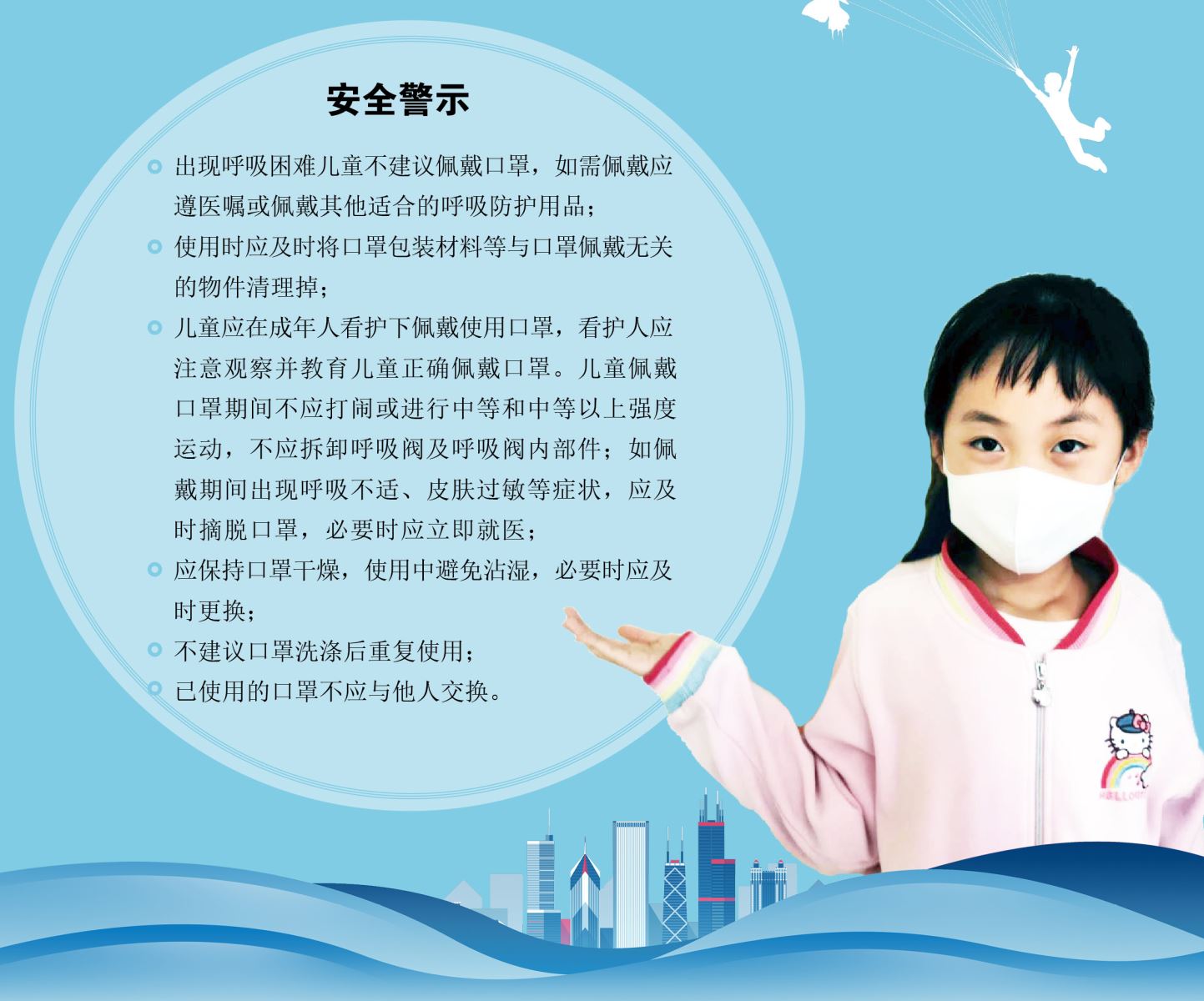
4 children mask wearing safety warning
Previous article
More information

Follow us
Hello, what can we do for you?
Copyright © Xiantao Dexing Plastic Products Co., Ltd / Xiantao Dexing Health Technology Co., Ltd | Powered by:300.cn
SAF Coolest v1.3.1.2 设置面板 FZUSD-ZSNG-OSSQE-ZWE
无数据提示
Sorry, the current column is being updated, please look forward to it!
You can view other columns or returnHome Page