


News Center
News Center
Industry Operation | Investigation and Analysis Report on Business Operation of Industrial Textile Industry Enterprises from January to April 2022
Release time:
2022-05-30
Since the beginning of this year, affected by adverse factors such as repeated epidemics and rising structural costs, the downward pressure on the industrial textile industry has increased. In order to better analyze the current operating conditions of the industrial textile industry, understand the current production and operation status of enterprises in the industry and the impact of the epidemic, Provide targeted consulting suggestions to enterprises, industries and government departments, the China Industrial Textile Industry Association recently carried out an online survey on the operation of enterprises in the industry in 2022.
Since the beginning of this year, affected by adverse factors such as repeated epidemics and rising structural costs, the downward pressure on the industrial textile industry has increased. In order to better analyze the current operating conditions of the industrial textile industry, understand the current production and operation status of enterprises in the industry and the impact of the epidemic, Provide targeted consulting suggestions to enterprises, industries and government departments, the China Industrial Textile Industry Association recently carried out an online survey on the operation of enterprises in the industry in 2022.
Basic Situation of 1. Interviewed Enterprises
The enterprises interviewed in this survey came from the sample database of the association statistics and received a total of 118 valid questionnaires within 4 days. From a regional perspective, the interviewed companies are mainly concentrated in Jiangsu, Zhejiang, Shandong and Guangdong, accounting for 72.17 of the total. The remaining interviewed companies are mainly distributed in Fujian, Anhui, Hubei, Hebei and Henan, basically covering my country's industrial use. The main producing areas of textiles. From the perspective of industry distribution, the interviewed companies are mainly distributed in the fields of non-woven fabric coils, medical and sanitary textiles, safety and protection textiles, filtration and separation textiles, thread tapes, rope nets, interlining fabrics, etc.
2. January-April 2022 Industry Operation
The operation of the (I) industry continues to be under pressure, and the business climate index is close to the critical value.
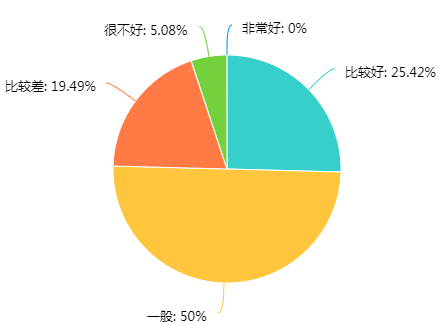
The enterprises surveyed were not very satisfied with their business conditions in the first four months. No enterprises thought that the current business conditions were "very good", 25.42 per cent thought that the business conditions were "relatively good", half thought that the business conditions were "average", and 24.58 per cent thought that the business conditions were "relatively poor" and "very bad", as shown in Figure 1. Compared with January-February, the proportion of enterprises that considered their business conditions "very good" and "relatively good" decreased by 11.53 percentage points and 14.92 percentage points respectively, the proportion of enterprises that considered their business conditions "average" increased by 7.63 percentage points, and the proportion of enterprises that considered their business conditions "relatively poor" and "very bad" increased by 14.41 percentage points and 4.4 percentage points respectively.
Figure 1 Business Situation of Respondent Enterprises from January to April 2022
Data source: China Industrial Textile Industry Association
The business situation is indexed, and the business climate index for January-April is 50.4, which is on a clear downward trend compared to January-February (73.1) and is close to the business climate threshold (50). In terms of different fields, only the prosperity index of geotechnical and construction textiles and special textiles is better than the overall level of the industry. Among them, the prosperity index of special textiles has reached 68.2, and the prosperity index of nonwovens, safety and protective textiles has fallen below the line of prosperity. The interviewed enterprises in the field of medical and sanitary textiles are mainly sanitary materials enterprises. As the sanitary materials industry is currently in the traditional off-season, the prosperity of this field has declined, however, the interviewed enterprises related to the production of epidemic prevention materials are developing well. As shown in Figure 2 (Note: The indices in this report all have a critical point of 50, above 50 indicates that the indicator is in an upward range, and the higher the index value, the higher the growth rate).
Figure 2 Business climate index by sector (not shown in areas with less than 10 samples)

Data source: China Industrial Textile Industry Association
The downward pressure on the (II) economy increased and production remained stable.
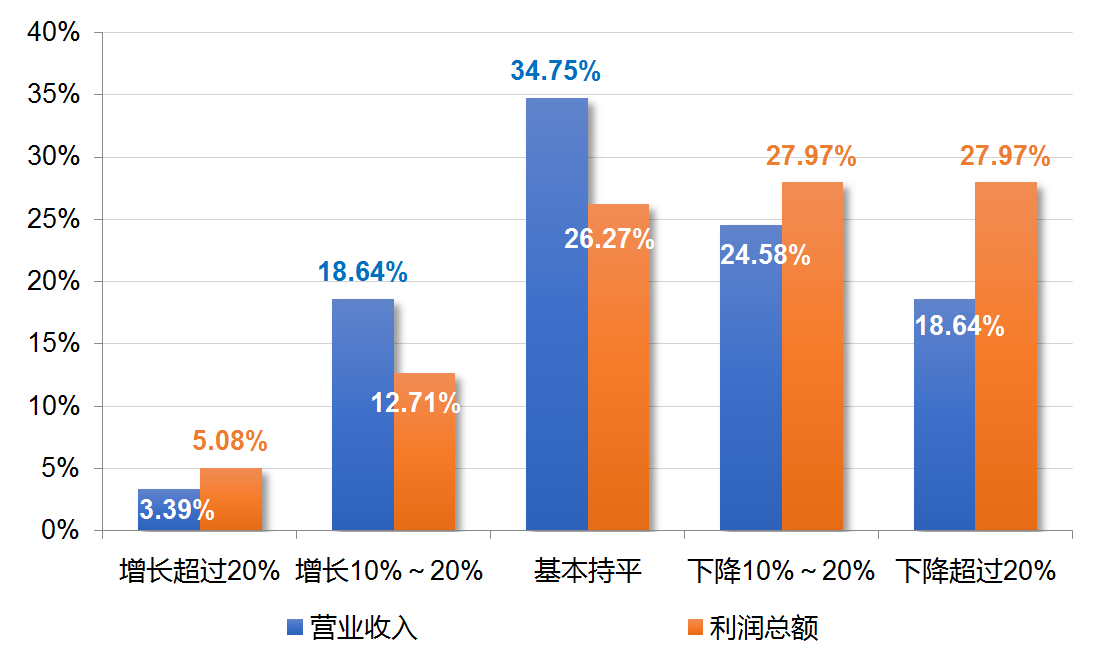
Judging from the economic benefits of the interviewed enterprises from January to April, the fluctuation is obvious compared with the same period in 2021. The operating income of more than 40% of the enterprises decreased by more than 10%, the operating income of 34.75 of the enterprises was basically the same, and the operating income of 22.03 of the enterprises increased by more than 10%. In terms of profit, the total profit of 55.93 of the enterprises decreased by more than 10% compared with the same period in 2021, and the total profit of 26.27 of the same period was basically the same, total profits of 17.80 per cent of firms rose by more than 10 per cent, as shown in Figure 3.
Figure 3 Changes in total operating income and profits of interviewed enterprises
Data source: China Industrial Textile Industry Association
In terms of production, more than 80% of the surveyed enterprises have reached a capacity utilization rate of more than 60%, and more than 60% of the enterprises said that the output of major products was basically the same or increased by more than 10% compared with the same period in 2021. Among them, the output of geotechnical and construction textiles, filtration and separation textiles, special textiles and other sub-fields increased significantly year-on-year.
(III) market demand as a whole weakens, and international market expansion encounters bottlenecks
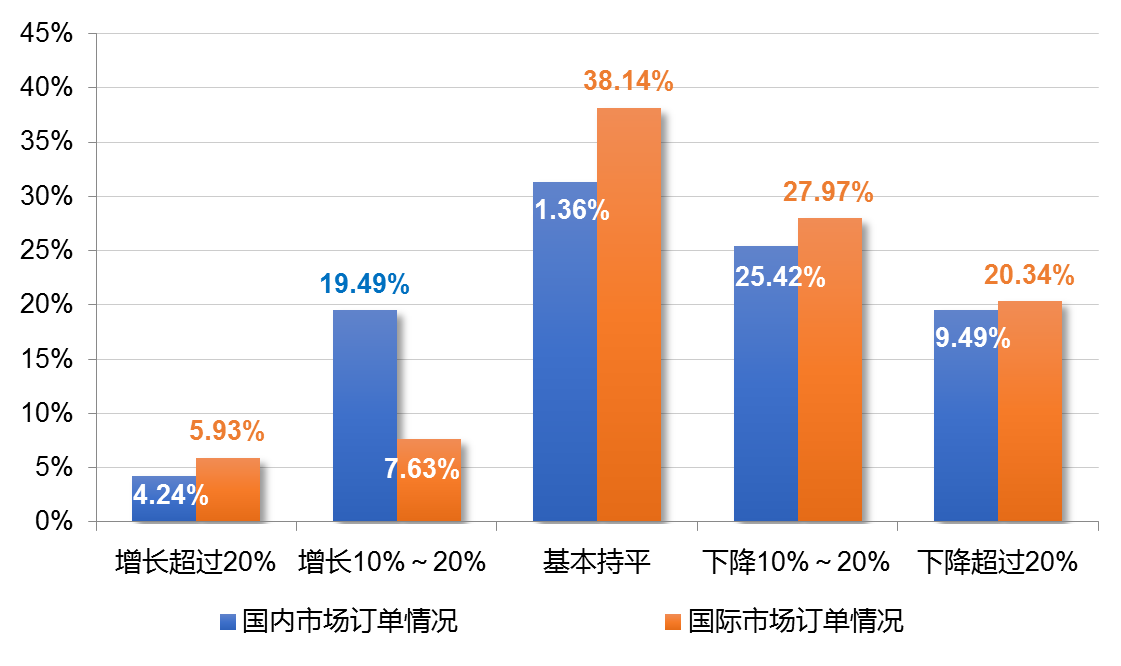
For the current order situation, the interviewed enterprises generally said that the order volume decreased significantly compared with the same period in 2021, the domestic order index was 46.0, the international order index was 38.5, both fell to the contraction range, as shown in Figure 4. The epidemic has made the industry relatively blocked from the international market for a long time, and the changes in shipping costs have made it more difficult for the industry to maintain and expand foreign markets.
Figure 4 International and domestic orders of interviewed enterprises
Data source: China Industrial Textile Industry Association
(IV) to overcome the impact of the epidemic, the industry resumed work and production in good condition
The recent domestic epidemic as a whole showed a stable downward trend, but the pressure to prevent rebound is still large, some areas affected by the outbreak of local enterprises to stop production frequently. Judging from the feedback from the companies interviewed this time, the current industrial textile industry companies can still maintain normal production and operation activities, and there is no large-scale shutdown and production suspension. Since 2022, 61.02 per cent of enterprises have said that there has been no shutdown, while the rest have said that they have been or are facing shutdown. Of the enterprises that have stopped production, 84.78 per cent said they have resumed normal production and 15.22 per cent said they are still in a shutdown state due to insufficient orders, poor operation or low employee attendance. No enterprises interviewed were found to have stopped production due to epidemic prevention and control measures, and enterprises in some areas with severe outbreaks temporarily adopted "closed-loop management" to maintain operations.
Currently, the workforce stability of the surveyed enterprises is high, the staff turnover rate is low, and nearly 90% of the enterprises have the same or increased the number of employees compared with the end of 2021.
High operating costs for (V) companies and blocked price transmission
The prices of major raw materials in the industrial textiles industry have entered an upward channel since 2021 and are still at a high level, with the raw material price index reaching 72.0, with more than 80 per cent of enterprises surveyed saying that raw material prices have risen to varying degrees and 44.83 per cent saying that they have risen by more than 10 per cent. The enterprise labor cost index is 72.8, and 47.41 percent of enterprises said that the labor cost increased by more than 10%. The high operation of raw material costs and labor costs did not drive the simultaneous increase in corporate product prices. Nearly 60% of corporate product prices remained basically unchanged. The price index of corporate main products was 41.8, which has fallen to contraction compared with the beginning of the year (56.9). In the range, the prices of products in sub-fields such as medical and sanitary textiles and nonwovens have dropped significantly.
3. 2022 Annual Expectations and Development Proposals
For the development of the whole year of 2022, 54.24 percent of the surveyed enterprises expressed a certain degree of optimism. Geotechnical and construction textiles, filtration and separation textiles, and specialty textiles companies are relatively optimistic about their business expectations in 2022, while companies in sub-sectors such as medical and sanitary textiles, nonwovens, and thread tapes are more cautious about their forecasts for the year.
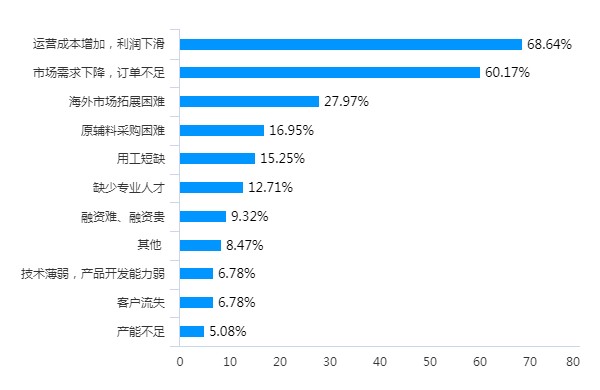
For the current difficulties faced by enterprises in the process of operation, the increase in operating costs and the decline in market demand are the two most selected by the interviewed enterprises. Difficulties in overseas market expansion, difficulties in purchasing raw and auxiliary materials and labor shortage are also problems reflected by enterprises, as shown in Table 1.
Table 1 Current main difficulties faced by surveyed enterprises
Data source: China Industrial Textile Industry Association
As for the external challenges faced by enterprises, the problems reflected by the interviewed enterprises are mainly concentrated in the two aspects of the increase of logistics and transportation costs and the sharp fluctuation of raw material prices. In addition, the excessive expansion of industry production capacity, the high sea freight and the obstruction of business activities are also the problems reflected by enterprises, as shown in Table 2.
Table 2 Key external challenges faced by surveyed firms
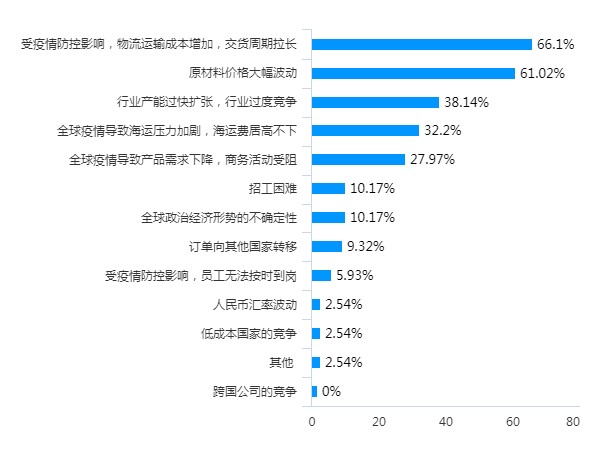
Data source: China Industrial Textile Industry Association
In view of the current difficulties and external challenges facing the industry, the policy demands of the interviewed enterprises mainly focus on logistics protection, tax reduction and fee reduction, financial support and so on. It is recommended that relevant departments introduce and implement relevant policies and measures to ensure smooth logistics and transportation, and promote the stability of the industrial chain supply chain; formulate preferential tax policies according to the actual situation of enterprises to effectively reduce the operating burden of enterprises; for industrial textiles that are greatly affected by the epidemic but have good development potential Enterprises increase financial support, extend or renew loans to enterprises that have difficulties in repayment due to the impact of the epidemic; resume the international business activities of enterprises in an orderly, stabilize and expand the international market.
In 2022, the industrial textile industry is facing a more complex and severe development environment, and the production and operation of enterprises are also under greater pressure. In this context, the industry should strengthen its confidence in development, actively implement the decisions and arrangements of the CPC Central Committee and the State Council, strengthen product development, consolidate internal management, promote staff training, optimize and improve product quality, and strive to expand new markets and new applications. to ensure the healthy and stable operation of the industry.
More information

Follow us
Hello, what can we do for you?
Copyright © Xiantao Dexing Plastic Products Co., Ltd / Xiantao Dexing Health Technology Co., Ltd | Powered by:300.cn
SAF Coolest v1.3.1.2 设置面板 FZUSD-ZSNG-OSSQE-ZWE
无数据提示
Sorry, the current column is being updated, please look forward to it!
You can view other columns or returnHome Page