


News Center
News Center
2020 China Industrial Textiles Industry Development Report
Release time:
2021-04-27
2020 is an extraordinary year for my country's industrial textile industry. In the face of the new coronary pneumonia epidemic sweeping the world, the industry has made every effort to ensure the production of epidemic prevention materials and related raw and auxiliary materials, and actively explore domestic and foreign markets. It has not only made important contributions to the prevention and control of the global epidemic, but has also developed rapidly, giving full play to the role of the growth pole of the textile industry.
Economic performance of industrial textiles industry in 2020
2020 is an extraordinary year for my country's industrial textile industry. In the face of the new coronary pneumonia epidemic sweeping the world, the industry has made every effort to ensure the production of epidemic prevention materials and related raw and auxiliary materials, and actively explore domestic and foreign markets. It has made important contributions to the prevention and control of the global epidemic, and it has also developed rapidly, giving full play to the role of the growth pole of the textile industry.
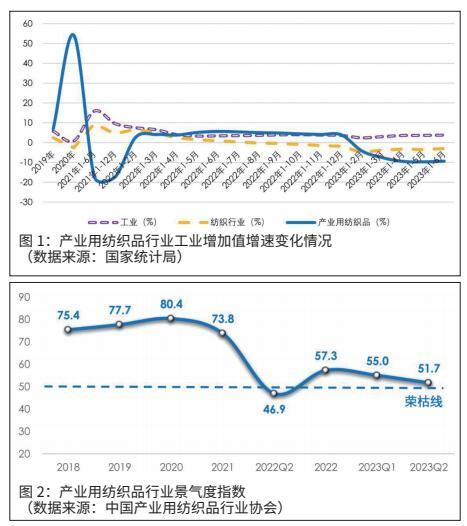
According to data from the National Bureau of Statistics, in 2020, the industrial added value of enterprises above designated size in my country's industrial textile industry increased by 54.1 year-on-year (pictured). According to the China Industrial Textiles Industry Association (hereinafter referred to as the "Association") on 330 sample enterprises, the industry's prosperity index in 2020 is 80.4, higher than the level of the same period last year, in a higher boom range.
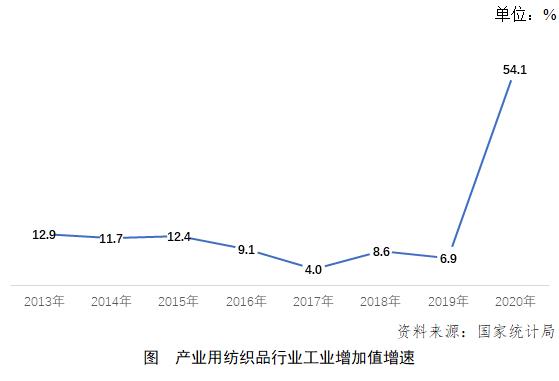
Strong growth in 1. production
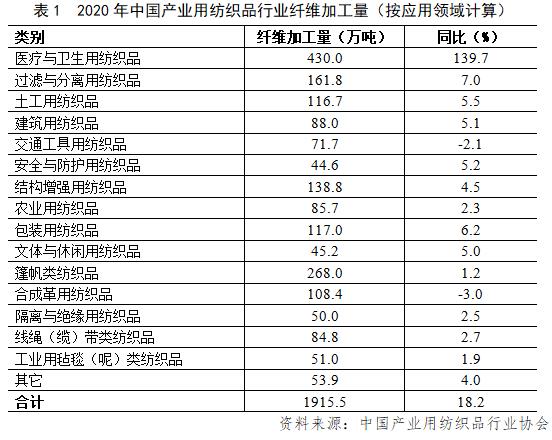
During the "13th Five-Year Plan" period, my country's industrial textile industry adheres to the concept of high-quality development, accelerates the adjustment and upgrading of industrial structure, and has become the world's largest producer of industrial textiles. After the outbreak of the epidemic, the industry has formed the production and supply capacity of emergency prevention and control materials such as masks and protective clothing in a short period of time, providing a strong guarantee for the life, health and safety of front-line medical staff and the broad masses of the people. According to the research of the association, the total fiber processing volume of China's industrial textile industry reached 19.155 million tons in 2020, an increase of 18.2 percent over the same period last year (see Table 1), and the average annual growth rate during the 13th five-year Plan period was 7.2 percent. As the main raw material for industrial textiles, the output of nonwovens in China was 8.788 million tons, an increase of 35.9 percent over the same period last year, and the average growth rate during the 13th five-year was 13.2 percent.
Good 2. economic benefits
According to data from the National Bureau of Statistics, in 2020, enterprises above designated size (not full-caliber) in the industrial textile industry will achieve operating income of 319.84 billion billion yuan, an increase of 32.6 percent over the same period last year, and total profits of 36.53 billion billion yuan, a significant increase of 203.2 percent over the same period last year. The industry's average profit margin was 11.4 percent, up 6.4 percentage points year-on-year.
By field, in 2020, the operating income of China's above-scale nonwovens enterprises was 175.28 billion yuan, up 54.0 percent year-on-year, the total profit was 24.52 billion yuan, up 328.1 percent year-on-year, and the gross profit margin and profit margin were 23.8 percent and 14.0 percent, respectively, both up 9.0 percentage points year-on-year; the operating income and total profit of enterprises above the scale of other industrial textiles in which medical and health, filtration and geotechnical textiles are located reached 73.01 billion yuan and 9 billion yuan respectively, up 35.4 percent and 175.1 percent respectively over the same period last year, and the gross profit margin and profit margin reached 23.0 percent and 12.3 percent respectively, second only to nonwovens in the industry.
The operating income of enterprises above the scale of ropes, ropes and cables, which are not highly related to epidemic prevention materials, was 14.4 billion yuan, up 6.9 percent year-on-year, and the total profit was 0.48 billion yuan, down 3.3 percent year-on-year, the gross profit margin was 13.7 percent, up 1.2 percentage points year-on-year, and the profit margin was 3.3 percent, down 0.4 percentage points year-on-year; the total operating income and profits of enterprises above the scale of awning and canvas reached 25.63 billion yuan and 1.46 billion yuan respectively, up 5.3 and 16.5 respectively from the same period last year. The gross profit margin and profit margin increased slightly by 1.2 and 0.6 percentage points respectively, and the profitability of the industry continued to improve. The total operating income and profits of enterprises above the scale of textile belts and cord fabrics were 31.51 billion yuan and 1.06 billion yuan respectively, down 11.8 and 18.2 respectively from the same period last year, however, benefiting from the recovery of the downstream market and the gradual return of overseas textile trade orders, corporate efficiency continued to repair, with gross profit margin of 12.8 per cent, up 0.7 percentage points year-on-year, and profit margin of 3.4 per cent, down 0.3 percentage points year-on-year (see table 2).
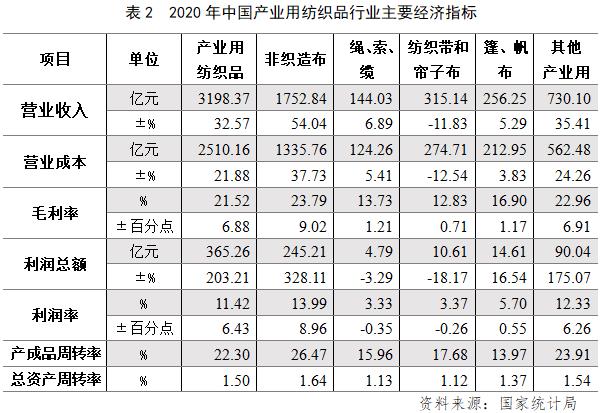
Affected by the epidemic, the business differentiation among enterprises in the industry continued to expand in 2020, with 325 enterprises above the scale of the industrial textile industry experiencing losses, with losses reaching 13.5 per cent, and losses of loss-making enterprises increasing by 10.8 per cent year-on-year.
The economic efficiency of large enterprises is obviously better than that of small and medium-sized enterprises. According to the statistics of the association, the operating income and total profit of all sample enterprises increased by 40.7 and 201.2 respectively, with a profit margin of 18.6. For enterprises with operating income of more than 0.5 billion yuan, the year-on-year growth rate of operating income and total profit reached 61.4 per cent and 330.9 per cent respectively, with a profit margin of 21.4 per cent; for enterprises with operating income of between 0.1 billion yuan and 0.5 billion yuan, the year-on-year growth rate of operating income and total profit was 20.2 per cent and 86.1 per cent respectively, with profit margins falling to 14.2 per cent; while for enterprises with operating income of less than 50 million yuan, its operating income fell 4.9 per cent year-on-year, its total profit grew by only 2.2 per cent year-on-year, and its profit margin fell to 5.7 per cent, mainly from various industrial clusters.
3. investment heat rises sharply
In early 2020, due to the outbreak of the new coronary pneumonia epidemic, the supply of nonwovens for the production of epidemic prevention materials is tight, prices rise, attracting a large number of social capital into the industrial textile industry, investment is mainly concentrated in meltblown, spunbonded and spunlaced nonwovens, masks and other fields, a number of industry backbone enterprises also announced capacity expansion plans.
According to the statistics of the association on the sample enterprises, the fixed asset investment of Chinese nonwovens industry enterprises increased by 210 year-on-year in 2020. According to incomplete statistics, in 2020, China's contract added 510 new spunbond nonwovens production lines, more than 2000 meltblown nonwovens production lines, about 160 spunlace nonwovens production lines, and about 170 needle-punched nonwovens production lines, with a total new production capacity of more than 3 million tons. The new meltblown nonwovens production capacity equipment in the industry in 2020 is relatively simple, and the technical level is not high. After the price of meltblown nonwovens has fallen, a large number of production capacity has chosen to withdraw. The industry backbone enterprises have rich market experience, have a deep understanding of equipment and industry, and pay attention to technological innovation and product differentiation when investing.
The significant investment in the industry in 2020 is, on the one hand, due to the fact that enterprises are more optimistic about the development prospects of the industry and make layout in advance; on the other hand, enterprises have the financial resources to improve production conditions and product structure after the financial situation has improved significantly.
4. imports and exports grew, and exports of epidemic prevention materials increased significantly.
(I) exports
According to China's customs data, in 2020, China's exports of various types of industrial textiles (not full caliber) worth 89.6 billion billion U.S. dollars, an increase of 197.9 percent year-on-year.
From the main products, masks are the industry's largest export products, exports of about $52 billion, non-woven protective clothing export value of about $11 billion. By the end of 2020, China had exported 224.2 billion masks to the world, including 65 billion medical masks; 2.31 billion pieces of export protective clothing, including 0.773 billion pieces of medical protective clothing; and exports of cotton, gauze, bandages and other products to US $1.01 billion billion, up 19.7 percent year-on-year.
As the main raw material for epidemic prevention materials, the export volume of nonwovens reached 1.389 million tons, up 32.2 percent year-on-year, with a value of 5.05 billion U.S. dollars, up 62.5 percent year-on-year; the export of nonwovens-related products also maintained a certain growth rate, with the export of disposable sanitary products 2.27 billion U.S. dollars, up 8.6 percent year-on-year, and the export of wiping cloth 1.27 billion U.S. dollars, up 12.1 percent year-on-on-on-year. The export value of cord (cable) and textiles was 2.06 billion US dollars, an increase of 7.3 percent over the same period last year, while the export value of felt cloth and tents was 1.39 billion US dollars, basically the same as the previous year. Overseas orders for industrial coated fabrics and leather-based cloth products shrank due to the outbreak, with exports falling by 16.4 and 19.0 percent year-on-year, respectively (see Table 3).
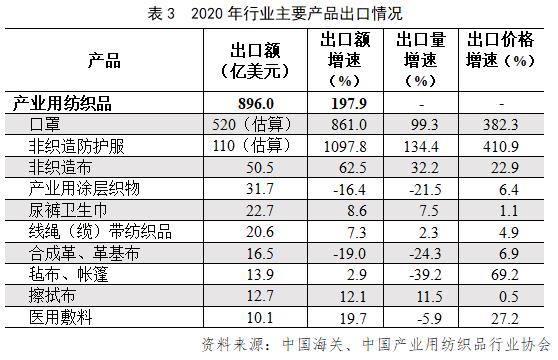
In 2020, the prices of the industry's main export products have increased to varying degrees, with the average export price of masks and non-woven protective clothing rising 382.3 percent and 410.9 percent year-on-year, respectively, driven by market demand.
(II) imports
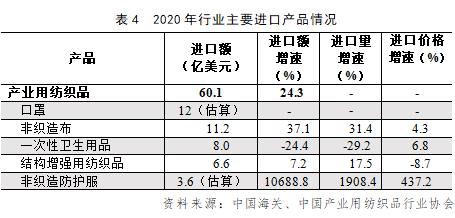
In recent years, with the continuous breakthroughs in technological innovation of China's industrial textiles, the demand for imported industrial textiles in China is decreasing year by year, but the outbreak of the epidemic has broken this law. In early 2020, due to the large capacity gap in medical masks and protective clothing, China began to purchase large quantities of masks, protective clothing and other epidemic prevention materials from overseas markets to meet domestic epidemic prevention needs. According to incomplete statistics, in 2020, China's imports of industrial textiles worth 6.01 billion billion U.S. dollars, an increase of 24.3 percent over the same period last year.
Among the main imported products, masks have the largest import demand, with an import value of about US $1.2 billion, of which the import value in the first four months accounted for more than 70% of the total import value, the import value of non-woven fabrics and non-woven protective clothing was respectively US $1.12 billion and US $0.36 billion, and the import value of textiles for structural enhancement reached US $0.66 billion, an increase of 7.2 per cent over the same period last year, the decrease reached 24.4 per cent (see table 4).
Industry Development Outlook and Forecast in 2021
2021 is the first year of the implementation of the "14th Five-Year Plan". my country will embark on a new journey of building a modern socialist country in an all-round way and march towards the second centenary goal. my country's industrial textile industry will also usher in the forefront of the world. Important period.
At present, the industrial textile industry has entered a period of opportunity and window period for rapid development and industrial upgrading. There is huge room for future development. At the same time, the industry is also facing the pressure of adjustment and stable development after rapid growth. With the advent of the post-epidemic era, industry enterprises should be prepared in a timely manner, strengthen technological innovation and professional personnel training, vigorously promote the upgrading of intelligent manufacturing and green manufacturing, make up for the shortcomings of the industry, promote the upgrading of industrial formats, and enhance the independent control of the supply chain.
It is expected that in 2021, China's industrial textile industry production and sales growth rate will appear a significant correction, with the global epidemic recently tends to ease, the demand for epidemic prevention materials will further decline, the demand for non-epidemic prevention materials will gradually pick up. The industry's fixed asset investment, especially the investment in expanding production capacity, will become more cautious, but the investment in intelligent transformation and green production will continue to maintain a certain growth.
Related Notes:
① Regarding the output growth data of non-woven fabrics in 2020, according to the actual production situation of my country's spunlaced non-woven fabric industry, the association revised the output of my country's spunlaced non-woven fabrics in 2019 to 950000 tons, and at the same time adjusted the output of my country's non-woven fabrics in 2019 to 6.469 million tons, so as to obtain a year-on-year growth rate of 35.9 in 2020.
The import and export data of masks and non-woven protective clothing in this paper are estimated according to the customs tariff number "63079000" and "62101030" respectively.
More information

Follow us
Hello, what can we do for you?
Copyright © Xiantao Dexing Plastic Products Co., Ltd / Xiantao Dexing Health Technology Co., Ltd | Powered by:300.cn
SAF Coolest v1.3.1.2 设置面板 FZUSD-ZSNG-OSSQE-ZWE
无数据提示
Sorry, the current column is being updated, please look forward to it!
You can view other columns or returnHome Page