


News Center
News Center
The Impact of US Tariffs on Industrial Textiles Industry
Release time:
2018-07-17
On July 6, the United States formally imposed a 25% tariff on US $34 billion of Chinese products, and China subsequently imposed a 25% tariff on US goods of the same size. This round of Chinese tariffs on the United States products include an important raw material for the textile industry-cotton.
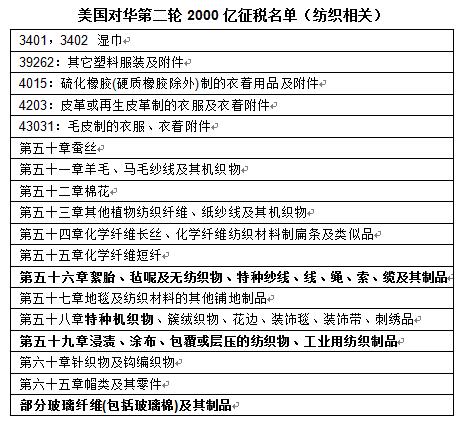
On July 11, the United States announced a 10% tariff on 200 billion goods from China. This tax involves products with more than 6000 tax numbers. The tax list is 205 pages long and includes textile-related products such as fibers, textile materials, hats and glass fiber fabrics. Clothing, apparel, home textiles, and footwear products are not included in this catalog.
First, the impact of cotton tariffs on the industry.
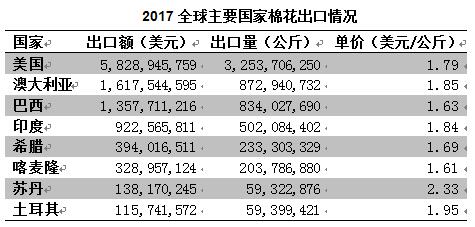
In 2017, China consumed 7.55 million tons of cotton and imported 1.15 million tons of cotton, of which 505300 tons came from the United States, accounting for 44%. Within the quota, the tariff will increase from 1% to 26%, and the import cost per ton will increase by more than 3500 yuan. Industrial textile enterprises, interlining, canopy enterprises have a certain amount of cotton, some enterprises use American cotton, tariff increases will have an impact on enterprises, but can be partially resolved by importing cotton yarn. In the industry, pure cotton spunlaced nonwovens enterprises directly use cotton, and the increase in US cotton tariffs will have a greater impact on the cost of these enterprises. At present, the production capacity of pure cotton nonwovens in China is about 70000 tons, and the demand for cotton is much smaller than that of traditional cotton spinning, so products from other regions can be used to replace US cotton. Therefore, the increase in import tariffs on US cotton will not have a significant impact on industrial textiles in the short term.
II. Impact of the second round of tariff hikes
According to the preliminary arrangement of the International Capacity Cooperation Alliance of Chinese Textile Enterprises, the products subject to the 10% tariff this time involve almost all the products in the HS50-60 chapter. Including all yarns, fabrics/fabrics of various raw materials (cotton, wool, silk, hemp and chemical fibers), as well as industrial textiles and some textile machinery products, the annual export value to the United States is about US $4 billion.
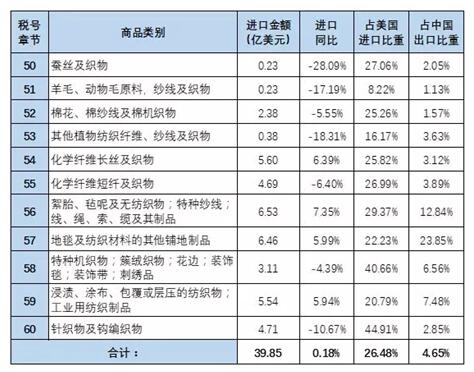
The current round of 200 billion tariffs involves almost all industrial textiles, but the following products are not in the catalog list:

In 2017, my country's industrial textiles exported to the United States were 3.74 billion million U.S. dollars, which is my country's largest export market for industrial textiles, accounting for 15.4 percent of my country's total exports. my country's dependence on the U.S. market is not very high.
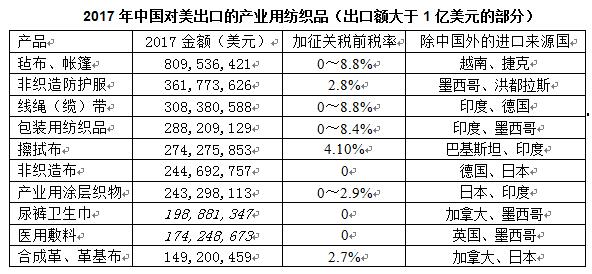
Among the main products listed in the above table, China is the largest exporter to the United States, but the share of Chinese products in the U.S. import market is not very high, Germany, Japan and other developed countries, Vietnam, India and other emerging developing countries, Canada, Mexico and other neighboring countries to the United States exports are relatively large. For example, the share of Chinese nonwovens in the U.S. import market is 22.7 percent, and the share of Germany, Japan, Canada and Mexico has reached 33 percent.
The 10% tariff increase will have a greater impact on the export of industrial textiles to the United States. Taking non-woven fabrics as an example, the tariff rate of imported non-woven fabrics in the United States is 0. After imposing a 10% tariff on Chinese non-woven products, the price advantage of Chinese products will decline, and European, American and Japanese companies have also accelerated their presence in the United States. The investment layout of the market will affect the export of my country's non-woven industry to a certain extent, and may change the global supply chain structure of non-woven fabrics in the long term. Important non-woven products such as medical dressings, non-woven protective clothing and diaper sanitary napkins are not on this list, which has eased the pressure on the domestic non-woven industry to a certain extent.
Felt cloth, tent, rope (cable) belt, industrial coated fabric, synthetic leather, leather base cloth and other industries with technological and cost advantages in China, it is difficult for other developing countries to establish a complete industrial chain to challenge our market position.
Therefore, the impact of the 10% tariff imposed by the United States on 200 billion Chinese goods on the export of China's industrial textile industry is controllable in the short term, but in the long run, it may change the global supply chain system. It is necessary to arouse the attention of the industry, especially the backbone enterprises, and consider the countermeasures in advance.
More information

Follow us
Hello, what can we do for you?
Copyright © Xiantao Dexing Plastic Products Co., Ltd / Xiantao Dexing Health Technology Co., Ltd | Powered by:300.cn
SAF Coolest v1.3.1.2 设置面板 FZUSD-ZSNG-OSSQE-ZWE
无数据提示
Sorry, the current column is being updated, please look forward to it!
You can view other columns or returnHome Page