


News Center
News Center
June starts bleak: after crude oil sealed the limit, cotton fell, cotton yarn hit the limit.
Release time:
2019-06-05
After the tragic end of May, global risk assets made another dismal start in June, the global risk aversion cloud is still hanging over the US-China relationship has become a key change in determining the market.
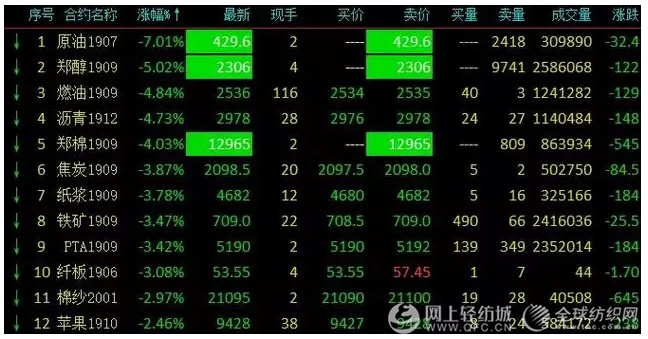
After the tragic end of May, global risk assets made another dismal start in June, the global risk aversion cloud is still hanging over the US-China relationship has become a key change in determining the market. News over the weekend hinted that the Sino-US trade dispute showed no signs of ending soon, while global trade tensions continued to rise and investors worried about the growing risk of economic recession. Today, cotton and cotton yarn futures fell across the board when they opened. Zheng Mian's main force once again hit a three-year low, closing at 12965 yuan/ton. Zheng Mian's main 1909 contract price has fallen by more than 3000 yuan/ton since mid-April.
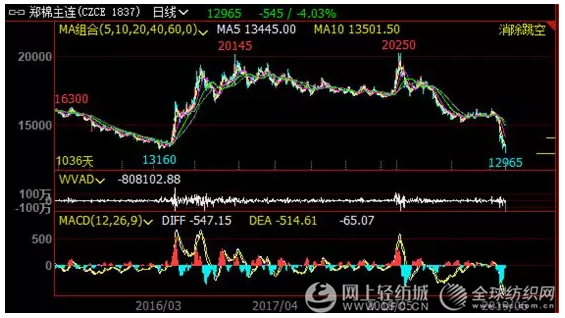
As we all know, the current external trade situation is tense, and the cotton spot market is pessimistic. For this Zheng cotton "off guard" limit, market participants have the following interpretation:
Green Dahua Futures researcher Cui Jiayue believes that the current cotton market is in an obvious weak market, in addition to the negative impact of Sino-US trade friction, the fundamentals of the pattern of supply and demand is also expected to be more pessimistic, coupled with the futures market warehouse receipt firm pressure unprecedented huge, contributed to the current continued downward and even repeated downward trend. Regarding the future trend, under the influence of the current short atmosphere, even if there is a rebound in the market, it will be greatly restricted. The sluggish market sentiment cannot be reversed in a short time.
The specific interpretation is as follows: 1, global risk assets suffered a big sell-off. The global market suffered a black May, panic, risk assets face a large-scale sell-off, the commodity market is a gloomy cloud, cotton as the Sino-US trade friction was implicated in the deeper varieties, the extent of the impact can be imagined, the future of the U.S. cotton futures prices further lower probability. 2, the domestic cotton fundamentals oversupply expectations are obvious. The current situation of domestic cotton fundamentals can be described as very bad. Supply side: cotton market resources are abundant. Throwing storage and social inventory and imports, so that manufacturers can choose and space is larger, the market to maintain a cautious attitude towards procurement. Demand side: due to the impact of Sino-US trade friction expectations, downstream textile exports are expected to decline, resulting in low demand expectations. Specifically reflected in: the import volume increased month-on-month; the reserve cotton auction was cold, and the volume and price fell; the domestic cotton social inventory remained at a high level in the past five years. 3, the futures market real pressure continues to increase. As of May 31, 2019, the number of cotton registered warehouse receipts in Zhengzhou Commodity Exchange was 18129, 462 less than last week, and the effective forecast was 943, 118 less than last week, totaling 19072, equivalent to 762900 tons, with a firm offer ratio of nearly 40%, much higher than the same period in previous years or even the highest level in history. The psychological pressure on the market is even greater than the substantial pressure.
Galaxy futures analyst Yan Baoteng said that recently, the domestic textile and garment industry export pressure increased. Downstream enterprise pressure gradually highlighted, gauze inventory increased, textile enterprises to stop production. At present, downstream enterprises dare not easily place orders, the consumer side is expected to be difficult to improve in the short term. However, Zheng cotton fell to the current position, the price is at a low level in the past three years, and it is also low in the long run, and it is currently the stage of cotton digestion inventory. These factors support cotton prices. It is recommended to wait and see for the time being and pay attention to the trend of cotton futures in the outer disk.
China Cotton Net Hu Yan believes that compared with last week, the cotton market has undergone some changes, which is likely to be the reason that triggered Zheng Mian's "jittery and jittery": First, the expectation of escalating Sino-US trade frictions has increased, and the United States has imposed tariffs on imports of Chinese US $325 billion goods to enter the "countdown". USTR will publish a notice in the Federal Register next week to extend the time for certain goods exported from China to enter the United States until June 15, after which tariffs on these goods will be raised from 10% to 25% (I. e., a 15-day buffer period). Since June 1, 2019, China has imposed additional tariffs of 25 per cent, 20 per cent and 10 per cent on some of the goods on the list of imports originating in the United States of about $60 billion (a 5 per cent tariff is still imposed on goods previously subject to a 5 per cent tariff). Some organizations believe that the white paper "China's position on Sino-US Economic and Trade consultations" points out that the responsibility for the setback in the negotiations lies with the United States, the United States has gone back on its promises three times, and China's four major positions are clear. Therefore, the possibility of short-term negotiations, concessions and agreement between China and the United States is very small. Second, last week, the U.S. stock market, bond market and financial markets plummeted, which in turn had an impact on the real economy and commodity markets. Cotton was not immune. Similarly, other stock markets in Germany, France and Europe are also "dark green". Today, domestic crude oil, PTA, asphalt, corn, rubber, cotton and other futures varieties all fell, but compared with other varieties, cotton has become the "vanguard" of commodity decline under the pressure of sufficient supply and demand and fine weather ". (China Securities Network, Green Dahua Futures, China Cotton Network)
More information


Follow us
Hello, what can we do for you?
Copyright © Xiantao Dexing Plastic Products Co., Ltd / Xiantao Dexing Health Technology Co., Ltd | Powered by:300.cn
SAF Coolest v1.3.1.2 设置面板 FZUSD-ZSNG-OSSQE-ZWE
无数据提示
Sorry, the current column is being updated, please look forward to it!
You can view other columns or returnHome Page