


News Center
News Center
2019 VAT rate will be lowered in the textile industry or will usher in a new spring
Release time:
2019-03-21
In the 2019 State Council Government Work Report, it is pointed out that a larger-scale tax reduction will be implemented this year, inclusive tax reduction and structural tax reduction will be implemented simultaneously, focusing on reducing the tax burden of manufacturing and small and micro enterprises, and reducing manufacturing and other industries The current 16% tax rate is reduced to 13%, and the current 10% tax rate in the transportation and construction industries is reduced to 9% to ensure that the tax burden of major industries is significantly reduced; the tax rate of 6% will remain unchanged, but through the adoption of supporting measures such as increasing tax deductions for production and life services, we will ensure that the tax burden of all industries will only be reduced but not increased, and continue to move towards the promotion of three and two tax rates and the simplification of the tax system. This
In 《2019In the report on the work of the government of the State Council, it is pointed out that a larger scale of tax reduction will be implemented this year, with both inclusive tax reduction and structural tax reduction, focusing on reducing the tax burden of manufacturing and small and micro enterprises, reducing the current 16% tax rate of manufacturing and other industries to 13%, and reducing the current 10% tax rate of transportation and construction industries to 9%, so as to ensure a significant reduction in the tax burden of major industries. Keep the 6% level unchanged, however, through the adoption of supporting measures such as increasing tax deductions for production and life services, we will ensure that the tax burden of all industries will only be reduced but not increased, and continue to move towards the promotion of three and two tax rates and the simplification of the tax system.This policy will be implemented from April 1.
I believe that many textile people are very concerned about when the specific implementation of the VAT tax reduction policy, which industries by the current tax rate.16%Dropped13%,10%Dropped9%Yes, how will the export tax rebate rate be adjusted and what impact will it have on the textile industry.
Last year's4Month4Day, the state decided2018Year5Month1The VAT rate has been adjusted since then, and the export tax rebate rate has been adjusted accordingly. As can be seen from the above,2018Proposed to reform and improve the value-added tax system, is a framework type, after nearly a month issued a specific implementation document, decided5Month1day implementation.
The goal of deepening VAT reform proposed this year is relatively clear. In addition, with the experience of reforming and improving the value-added tax system last year, there is reason to believe that the time for the introduction of specific policies may be faster, probably in5Month1The day began to implement.
So...Big drop in VAT!Which businesses will benefit?As was the case last year, the current rate of VAT, including manufacturing, is16%The industry, all down13%, the current VAT rate is10%The industry, all down9%. This is a sure-footed GSP tax cut.
Cotton import costs will be reduced
VAT on cotton imports will be reduced from the current10%Downregulation1percent9%The cost of imports will fall.From the perspective of the textile industry, the VAT rates for agricultural and industrial products are different, and the VAT on agricultural products is from10%Down9%, the tax rate for industrial products is increased from16%Down13%. For cotton, it belongs to agricultural products, while polyester short and sticky short belong to industrial products, which means that the competitive products of cotton (polyester short and sticky short) will be taxed at a higher rate than cotton. Therefore, the demand for cotton may be affected by the increased competitiveness of polyester short and sticky short.
Cotton, whether domestic or import and export transactions, its profit is almost only.1%, that is150-160Yuan/Tons of operating space. while the total tax reduction for downstream industrial goods (e. g. cotton yarn) is6%The reduction of VAT will bring more profits to enterprises in the short term, or enterprises will have greater bargaining power.
We take4Monthly import and export goods tariff exchange rate.6.7101Take70-150Cents/The price range of pounds of imported cotton can be calculated separately, under the new value-added tax rate, the theoretical cotton import cost can be reduced at least.100Yuan/About tons.
What is the impact on foreign trade export tax rebates?
In the medium and long term, taxes and fees have reduced the costs of almost all enterprises, and China's goods are more competitive, including China's textile and clothing exports.
The current VAT export rebate rate is16%,13%,10%,6%and0, a total of five gears. Referring to last year's practice, it is expected (note: it is expected, subject to the official documents issued by the Ministry of Finance and the State Administration of Taxation-editor's note) to be adjusted this year.13%,10%,9%,6%and0Still in fifth gear.
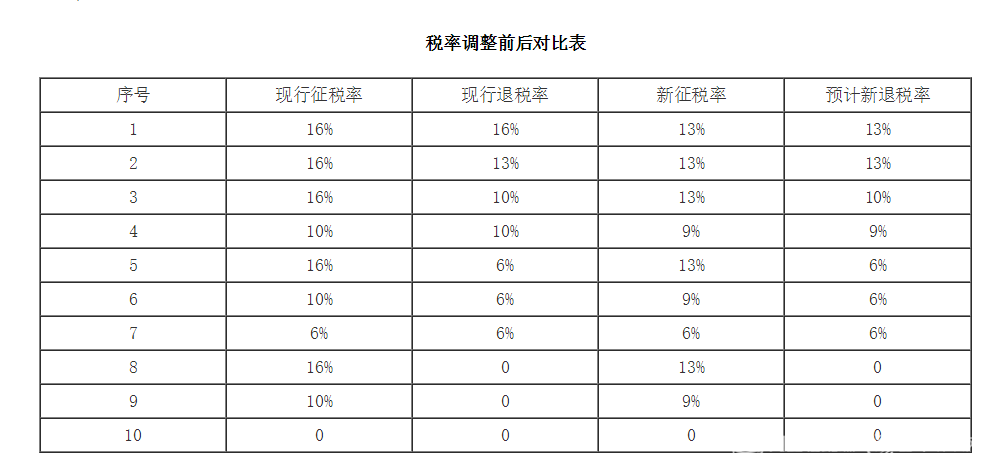
adjustment of policy,What is the impact on export enterprises?The tax rate is consistent with the tax rebate rate, and both are reduced by three or one percentage point: although in this case, the VAT rate is reduced before and after the reduction of the VAT rate, the implementation of a complete tax rebate, but due to the decline in the tax rate, the corresponding reduction in the enterprise's capital occupation, the impact on export enterprises is slightly more neutral.
Where the tax rate falls and the tax rebate rate does not fall:This situation increases the tax refund rate, which is beneficial to export enterprises. The decline in the tax rate and tax rebate rate may have a certain impact on the purchase and sale prices of export goods, especially for goods with weak bargaining power of export enterprises, corresponding preparations should be made early and corresponding countermeasures should be taken; for long-term trade contracts, it is necessary to take the initiative to negotiate with foreign businessmen in order to obtain their understanding and support.
In summary, the State Council intends to significantly reduce the VAT rate, except for individual tax rates and tax rebates.6%, as well as a small number of export non-tax-free and duty-free export goods and services, export enterprises are not affected by it, in general, the impact on export enterprises is positive and beneficial.
Cotton spinning enterprises will "take advantage"
The upcoming implementation of the "tax cuts" to the downstream weaving link.3-6A point of arbitrage space, speculative inventory short-term demand increased, expected tax cut advantage limit1Months and a half. for most mainland cotton mills,4Month1It is advantageous to sell cotton yarn after the day, while in Xinjiang,4Month1Buy cotton a few days ago and4Month1It is most advantageous to sell cotton yarn in the future. is the same for downstream fabric factories, if in4Month1Buy cotton yarn a few days ago, in4Month1Future sales of gray cloth, you can enjoy13%of VAT and16%input tax relief.
Domestic transactions are best understood as the lower the output tax rate and the higher the input tax rate, the less tax is paid. Through the division of VAT withholding at each stage, the purchase of raw materials before the tax reduction and the sale of finished products will create arbitrage space. The ginning mill basically ended the purchase of seed cotton, and its input tax rate for the current year was basically fixed10%At present, enterprises that still have lint can increase profits by selling invoices after tax cuts.;As many governments in mainland textile enterprises have revised the high levy and low deduction, the change time of the deduction tax rate of input tax is consistent with the reporting time of the output tax rate, not the invoicing time.(In addition, different places have different fine-tuning policies.);The other links are "purchasing raw materials before tax cuts and selling finished products after tax cuts" with the largest short-term spreads.
In the absence of external stimulus, the Chinese textile market continues to be in“Loose supply and cost support”During the period, the market is mainly based on demand. At present, through tax cuts, the downstream sector, especially the textile, printing and dyeing industry, short-term profit growth. Overall, the practice of preparing raw materials before tax reduction and selling after tax reduction is the most favorable, but there are capital costs and storage costs for inventory, which will cover the benefits of tax reduction over time. (Some references: Huarui Information, China Cotton Information Network, Global Textile Network Comprehensive Arrangement, please indicate the source for reprinting)
More information


Follow us
Hello, what can we do for you?
Copyright © Xiantao Dexing Plastic Products Co., Ltd / Xiantao Dexing Health Technology Co., Ltd | Powered by:300.cn
SAF Coolest v1.3.1.2 设置面板 FZUSD-ZSNG-OSSQE-ZWE
无数据提示
Sorry, the current column is being updated, please look forward to it!
You can view other columns or returnHome Page