


News Center
News Center
[Industry Operation] Operation Profile of Industrial Textile Industry in the First Quarter of 2023
Release time:
2023-06-05
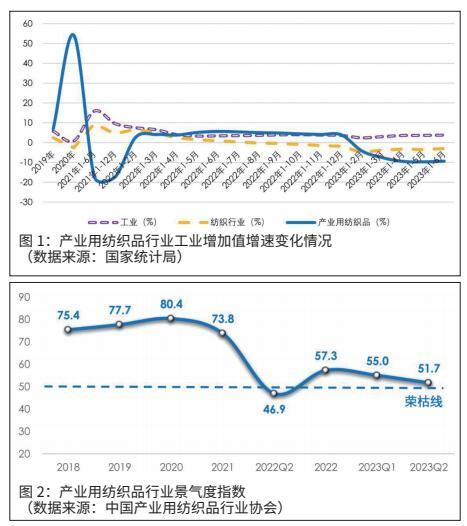
In the first quarter of 2023, affected by factors such as domestic demand repair less than expected and weakening external demand, the downward pressure on China's industrial textile industry increased, the industrial added value of the industry declined, and the main economic indicators were running at a low level. According to the research of the association, the prosperity index of the industrial textile industry in the first quarter was 55.0, which was in the "weak prosperity" range.
In the first quarter of 2023, affected by factors such as domestic demand repair less than expected and weakening external demand, the downward pressure on China's industrial textile industry increased, the industrial added value of the industry declined, and the main economic indicators were running at a low level. According to the research of the association, the prosperity index of the industrial textile industry in the first quarter was 55.0, which was in the "weak prosperity" range.
demand and production,According to the research of the Association, the order demand in the market in the first quarter decreased compared with the same period in 2022. The domestic market demand index and the international market demand index were 42.9 and 50.0 respectively. Among them, 31.7 of the surveyed enterprises had stable and continuous orders or orders for more than three months, and nearly half of the surveyed enterprises' orders could only support production within one month or half a month. Affected by this, according to the data of the National Bureau of Statistics, in the first quarter, the output of nonwovens and cord fabrics of enterprises above designated size decreased by 6.3 and 5.3 respectively.
In terms of economic benefits,According to data from the National Bureau of Statistics, in the first quarter, the operating income and total profits of enterprises above designated size in the industry fell by 3.6 and 36.5 respectively year-on-year, and the profit margin was 2.7, a year-on-year decrease of 1.4 percentage points. By sector, the first quarter.Nonwovensthe operating income of enterprises above designated size increased by 0.5 percent year-on-year, but their total profits decreased by 45.2 percent year-on-year, and their profit margin was 1.6 percent, a year-on-year decrease of 1.3 percentage points;Rope, rope, cableThe operating income and total profits of enterprises above designated size decreased by 13.3 and 45.1 respectively year-on-year, and the profit margin was 3.5, an increase of 2 percentage points year-on-year;Textile belt, cord fabricThe operating income and total profits of enterprises above designated size decreased by 6.9 and 55.1 respectively year-on-year, and the profit margin was 2.5, down 2.6 percentage points year-on-year;Canopy, canvasThe operating income and total profits of enterprises above designated size decreased by 17.1 and 39.3 respectively year-on-year, and the profit margin was 3.8, a year-on-year decrease of 1.4 percentage points;Other Industrial TextilesThe operating income and total profits of enterprises above designated size fell by 1.3 and 13.5 respectively year-on-year, and the profit margin was 4.7, down 0.7 percentage points year-on-year. According to the survey of the association, the industry raw material cost index, logistics cost index and labor cost index in the first quarter were 62.5, 64.6 and 75.4 respectively, and the cost pressure of enterprises has not been alleviated; based on the competitive pressure, the industry product price index in the first quarter was 44.6, which was in the contraction range. More than 85% of the interviewed enterprises said that the prices of their main products remained unchanged or even declined.
In the first quarter, the profitability of listed companies in the industry was under pressure. The operating income of 32 listed companies in the first quarter was basically the same as that in the same period in 2022, and the total profit decreased by 15.9 year-on-year. Among them, the operating performance of listed companies in filtration textiles and automotive textiles was under pressure.
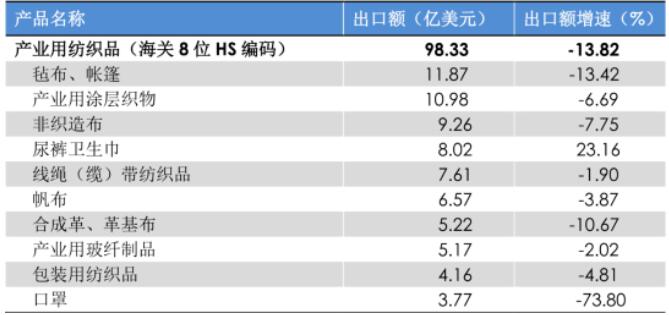
In international trade,According to China's customs data, in the first quarter of 2023, the export value of China's industrial textile industry (customs 8 HS code statistics) was 9.83 billion US dollars, down 13.8 percent from the same period last year; in the first quarter, the import value of the industry (customs 8 HS code statistics) was 1.23 billion US dollars, down 17.7 percent from the same period last year. By product, among the top 10 exports,Felt/Tent and Industrial Coated FabricsThe export value of more than 1 billion US dollars;NonwovensThe export volume was 293000 tons, down 2.8 percent year on year, and the value was 0.93 billion billion U.S. dollars, down 7.8 percent year on year;Disposable sanitary productsOverseas demand continued to be strong, with exports of US $0.8 billion billion, up 23.2 per cent year-on-year;Cord (cable) with textile, canvas, leather base clothDemand for traditional products, such as the weakening of exports, fell by 1.9 per cent, 3.9 per cent and 10.7 per cent year-on-year, respectively;Protective clothing made of masks and chemical fiber nonwovens (including medical protective clothing)Exports fell 73.8 per cent and 32.2 per cent year-on-year, respectively.
At present, the global economy is still in the tightening stage formed by the tightening of monetary policy in some developed economies, and the uncertainty faced by economic growth is high; the domestic economy shows obvious structural repair, but the repair process will continue for some time. Looking ahead to the second quarter, the momentum of China's economic repair will continue to be released, but the industry still needs to face a complex environment and the impact of multiple factors, the repair of operational quality will still take time; as the world is still in the downward period of the trade and inventory cycle, the downward pressure on industry exports in the second quarter is still significant. The majority of enterprises should strengthen their confidence, practice their internal skills, strengthen the development of differentiated products and cost management, actively respond to the challenge of rising rigid costs, and timely adjust the pace of investment and production to ensure the sustainable and healthy development of the industry.
Previous article
More information

Follow us
Hello, what can we do for you?
Copyright © Xiantao Dexing Plastic Products Co., Ltd / Xiantao Dexing Health Technology Co., Ltd | Powered by:300.cn
SAF Coolest v1.3.1.2 设置面板 FZUSD-ZSNG-OSSQE-ZWE
无数据提示
Sorry, the current column is being updated, please look forward to it!
You can view other columns or returnHome Page