


News Center
News Center
Brief Analysis of Economic Operation of Printing and Dyeing Industry from January to August 2022
Release time:
2022-10-31
From January to August 2022, the production of printing and dyeing industry continued to slow down, and the decline in printing and dyeing cloth output of printing and dyeing enterprises above designated size still showed an expanding trend. The main operation quality indicators fluctuated slightly, and the efficiency of industry production and marketing continued to improve. The growth rate of the main economic benefit indicators fell back, the total profit growth rate declined significantly, and the profit of enterprises was significantly under pressure.
From January to August 2022, the production of printing and dyeing industry continued to slow down, and the decline in printing and dyeing cloth output of printing and dyeing enterprises above designated size still showed an expanding trend. The main operation quality indicators fluctuated slightly, and the efficiency of industry production and marketing continued to improve. The growth rate of the main economic benefit indicators fell back, the total profit growth rate declined significantly, and the profit of enterprises was significantly under pressure.
Slow recovery of terminal demand
Insufficient release of enterprise capacity
According to data from the National Bureau of Statistics, from January to August 2022, the output of printing and dyeing cloth of enterprises above designated size in the printing and dyeing industry was 36.098 billion meters, a decrease of 8.34 percent year-on-year, and a decrease of 1.51 percentage points from January to July. On a month-on-month basis, the output of printing and dyeing cloth of printing and dyeing enterprises above designated size in August was 4.622 billion meters, 1.44 lower than that in July, and the monthly output continued to hit a new low in the year, reflecting that the contradiction of insufficient demand is still relatively prominent, and the overall capacity utilization rate of printing and dyeing enterprises is low. According to data from the National Bureau of Statistics, from January to August, the retail sales of clothing, shoes, hats, and knitwear products above the national quota decreased by 4.4 year-on-year, and the rate of decline narrowed by 1.2 percentage points from January to July, but fell 29.2 percentage points from the same period last year. Under the influence of factors such as the frequent spread of epidemics, the accelerated tightening of monetary policy in Europe and the United States, and the continuation of geopolitical risks, the recovery of consumer demand for textiles and clothing in the terminal market, especially in the domestic market, is relatively slow.
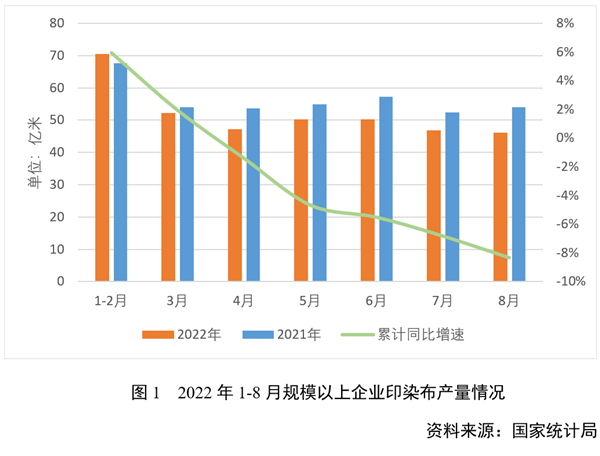
Operational quality indicators fluctuate slightly
Production and marketing convergence efficiency continues to improve
According to the data of the National Bureau of Statistics, from January to August 2022, the proportion of three fees for printing and dyeing enterprises above designated size was 6.38, down 0.49 percentage points from the same period of last year, of which cotton printing and dyeing enterprises were 6.19 and chemical fiber printing and dyeing enterprises were 7.64. The turnover rate of finished products was 17.07 times per year, down 1.72 from the same period last year. The turnover rate of accounts receivable is 8.63 times per year, up 0.61, 0.64 percent year-on-year. Compared with January-July, from January to August, the growth rate of accounts receivable turnover rate and total asset turnover rate of printing and dyeing industry dropped slightly by 0.47 and 1.78 percentage points respectively, and the decline rate of finished product turnover rate narrowed by 0.64 percentage points, showing a recovery trend for two consecutive months, and the efficiency of industry production and marketing convergence continued to improve.
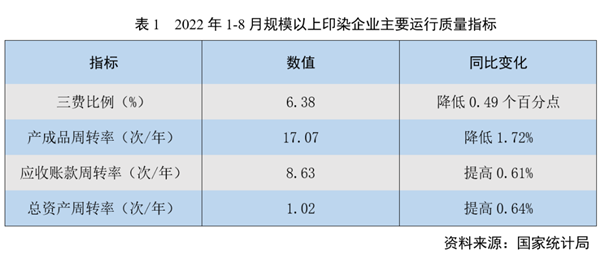
The growth rate of efficiency indicators fell.
Corporate earnings are under significant pressure
According to data from the National Bureau of Statistics, from January to August 2022, the operating income of printing and dyeing enterprises above designated size was 202.446 billion billion yuan, a year-on-year increase of 8.49 percent; the total profit realized was 7.617 billion billion yuan, a year-on-year increase of 0.86 percent; the cost and expense profit margin was 4.00 percent, a year-on-year decrease of 0.30 percentage points; the sales profit margin was 3.76 percent, a year-on-year decrease of 0.29 percentage points; the export delivery value was 26.561 billion yuan. The number of loss-making households of 1704 printing and dyeing enterprises above designated size was 572, with a loss area of 33.57; the total loss of loss-making enterprises was 2.229 billion billion yuan, a year-on-year increase of 58.95.
Since August, the main economic indicators of the printing and dyeing industry have been under obvious pressure. Compared with January-July, the growth rate of operating income of printing and dyeing enterprises fell by 2.03 percentage points, the growth rate of total profits fell by 9.21 percentage points, the decline rate of sales profit margin expanded by 0.28 percentage points, and the growth rate of total losses of loss-making enterprises increased by 7.66 percentage points. The growth rate of total profits of printing and dyeing enterprises has declined significantly, while the total losses of loss-making enterprises are still growing, reflecting that the pressure on production and operation of most enterprises is still great.
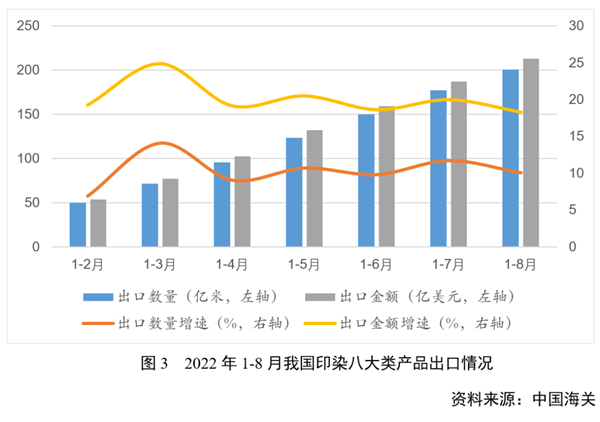
Foreign trade shows strong toughness
Export continued growth trend
According to Chinese customs statistics, from January to August 2022, the export volume of eight categories of printing and dyeing products was 20.085 billion meters, an increase of 10.06 percent over the same period last year; the export value was 21.286 billion billion US dollars, an increase of 18.31 percent over the same period last year; and the average unit price of exports was 1.06 US dollars per meter, an increase of 7.50 percent over the same period last year. In terms of products, from January to August, the export volume and export value of synthetic filament fabrics increased by 18.27 and 30.15 respectively compared with the same period last year, which accounted for the highest proportion of exports and the fastest growth among the eight categories of printing and dyeing products. Exports of cotton products fell sharply due to the impact of the so-called "Xinjiang Act" issued by the United States. Exports of pure cotton dyed cloth and pure cotton calico decreased by 17.11 and 20.54 respectively compared with the same period last year.
In general, the current printing and dyeing industry is still facing many unstable and uncertain factors, and the stage difficulties faced by printing and dyeing enterprises in production and operation are still large. In the face of high manufacturing costs and insufficient production orders, business pressure continues to increase. At the same time, under the influence of the epidemic, the overall domestic consumption is weak, and with Europe and the United States and other developed economies to accelerate the tightening of monetary policy, the international market consumption is expected to decline, the possibility of external demand reduction increases the export of China's printing and dyeing products to form a constraint. The realistic pressure for the industry to achieve steady development still exists, and the foundation for steady recovery still needs to be further consolidated.
(Source: China Printing and Dyeing Industry Association)
More information

Follow us
Hello, what can we do for you?
Copyright © Xiantao Dexing Plastic Products Co., Ltd / Xiantao Dexing Health Technology Co., Ltd | Powered by:300.cn
SAF Coolest v1.3.1.2 设置面板 FZUSD-ZSNG-OSSQE-ZWE
无数据提示
Sorry, the current column is being updated, please look forward to it!
You can view other columns or returnHome Page