


News Center
News Center
Operation Analysis of China's Industrial Textile Industry in the First Half of 2022
Release time:
2022-08-15
Since 2022, the domestic and international situation is complex and changeable, and the expected triple pressure and the two major shocks have caused a greater impact on the stable operation of the industrial textile industry. In the first quarter, the industrial value added of the industry returned to positive growth, but the industry economy, production and demand repair was slow; in the second quarter, driven by the steady growth policy, the industrial value added of the industry maintained growth, the decline in major economic indicators continued to narrow, and production and demand gradually recovered, but the downward pressure on the industry still exists. In the first half of 2022, the prosperity index of the industrial textile industry was 46.9, which was in the contraction range.
Since 2022, the domestic and international situation is complex and changeable, and the expected triple pressure and the two major shocks have caused a greater impact on the stable operation of the industrial textile industry. In the first quarter, the industrial value added of the industry returned to positive growth, but the industry economy, production and demand repair was slow; in the second quarter, driven by the steady growth policy, the industrial value added of the industry maintained growth, the decline in major economic indicators continued to narrow, and production and demand gradually recovered, but the downward pressure on the industry still exists. In the first half of 2022, the prosperity index of the industrial textile industry was 46.9, which was in the contraction range.
1. domestic demand urgently needs to pick up, capacity utilization picks up
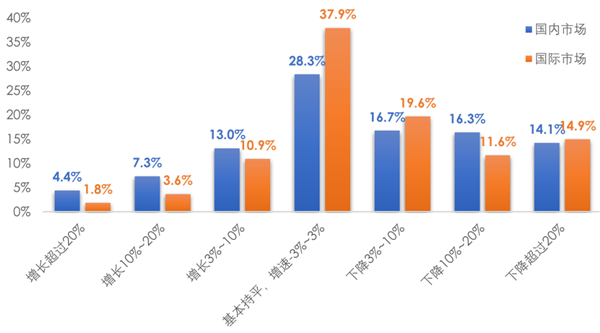
According to the association's survey of member companies, 47.1 and 46.0 percent of the surveyed companies said that the domestic and international market demand declined to varying degrees in the first half of this year (Figure 1), and the domestic and international market demand indexes were 38.8 and 35.1 respectively. Compared with January to April (39.7 and 33.2), the domestic market demand declined slightly, and the international market demand rebounded. In terms of different fields, the domestic demand market of structural enhancement textiles is strong, and the domestic market demand index of 68.8 is the highest in the industry; the international market has relatively high demand for transportation textiles, geotechnical and construction textiles, and the international market demand index of the two fields is 53.9 and 52.8 respectively.
Data source: China Industrial Textile Industry Association
Figure 1 Domestic and international market demand of industrial textiles industry in the first half of 2022
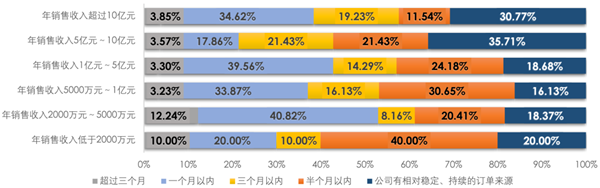
In terms of orders on hand, 26.4 per cent of respondents had a relatively stable and continuous source of orders or orders on hand could support production for more than three months, while 34.4 per cent of respondents had orders on hand to support production for less than one month. According to the size of the enterprise, the on-hand orders of large and medium-sized enterprises are more stable and sufficient, and can support longer production; while the on-hand orders of small and micro enterprises can only support production within one month or even half a month (Figure 2).
Data source: China Industrial Textile Industry Association
Figure 2 Orders in hand by enterprises in the industrial textiles industry in the first half of 2022 (by enterprise size)
Despite the sluggish market demand, with the effect of the logistics guarantee policy, the delivery cycle of enterprises has gradually shortened, and the industry's operating rate has generally increased. According to the association's survey, 10.5 percent of enterprises said they could produce at full capacity, up 2.9 percentage points from January to April, and 42.4 percent said their capacity utilization rate was around 80 percent, up 7.1 percentage points from January to April. According to the National Bureau of Statistics data, from January to June 2022, the output of non-woven fabrics of enterprises above designated size fell by 1.9 year-on-year, but the decline is narrowing month by month; affected by the decline in automobile production and sales, cord fabric production fell by 4.8 year-on-year.
The 2. industry is under pressure, and the high-cost pattern continues.
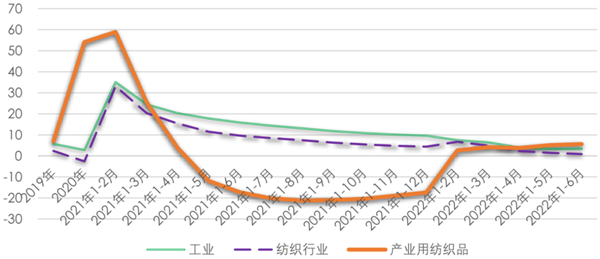
In the first half of 2022, the industrial added value of enterprises above designated size in China's industrial textile industry showed a steady upward trend (Figure 3). According to the National Bureau of Statistics, the operating income of enterprises above designated size in the industry was basically unchanged from the same period in 2021, with total profits down 16.8 percent year-on-year and profit margins down 4.9 percent, down 0.9 percentage points year-on-year.
Source: National Bureau of Statistics
Figure 3 Comparison of the growth rate of industrial value added
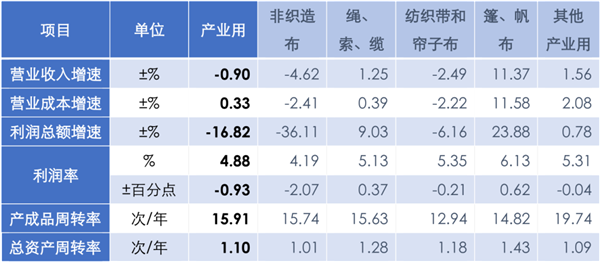
Compared with the same period in 2021, with operating income almost returning to the same period level, the increase in operating costs is the main reason for the decline in total industry profits. According to data from the National Bureau of Statistics, while the operating income of the industrial textile industry fell by 0.9 year-on-year, the industry's operating costs increased by 0.3 year-on-year, and the industry's gross profit margin fell by 1.0 percentage points year-on-year. According to the Association's research, the industry's raw material cost index and labor cost index reached 82.4 and 78.3 in the first half of the year, respectively, up from the same period in 2021 (79.3 and 76.3). Based on the competitive pressure, the increase of operating costs makes the industry enterprises bear the pressure of price difference. In the first half of the year, the industry product price index was only 40.6, which was in the contraction range. More than 80% of the surveyed enterprises said that the prices of major products remained unchanged or even declined.
From January to June, the operating income and total profits of nonwovens enterprises above designated size decreased by 4.6 and 36.1 respectively, and the profit margin was 4.2, down 2.1 percentage points; the operating income and total profits of enterprises above designated size of rope, rope and cable increased by 1.3 and 9.0 respectively, and the profit margin was 5.1, up 0.4 percentage points; the operating income and total profit of enterprises above the scale of textile belt and cord cloth decreased by 2.5 and 6.2 respectively, and the profit margin was 5.4, down 0.2 percentage points; the development momentum of awning and canvas industry was good, and the operating income and total profit of enterprises above the scale increased by 11.4 and 23.9 respectively, and the profit margin was 6.1, up 0.6 percentage points; the operating income and total profits of enterprises above the scale of other industrial textiles in which filtration and geotechnical textiles are located both returned to positive growth, up 1.6 per cent and 0.8 per cent year-on-year, respectively, with a profit margin of 5.3 per cent, basically unchanged from the same period in 2021 (Table 1).
Table 1 Main economic indicators of industry operation from January to June 2022 (enterprises above designated size)
Data source: According to the National Bureau of Statistics
3. foreign trade showed a repair trend, the decline in exports continued to narrow.
According to China's customs data, the export volume of China's industrial textile industry from January to June 2022 (customs 8-digit HS code statistics) was US $23.25 billion, down 13.6 percent from the same period last year, and the decline has narrowed for five consecutive months since February. Industry imports from January to June (customs 8-digit HS code statistics) were US $3.25 billion, down 14.2 percent from the same period last year. In terms of major export products, the overseas "camping economy" is in full swing, making felt/tents the largest export product in the industry, with exports reaching US $2.67 billion billion, up 17.3 percent year-on-year. Exports of industrial coated fabrics, string (cable) with textiles, canvas, leather-based fabrics and other traditional products increased 28.0 percent, 16.2 percent, 31.7 percent and 17.9 percent year-on-year respectively. Exports of nonwovens and related products showed different trends, with coil exports of US $2.03 billion, down 15.3 percent from the same period last year, and exports of 612000 tons, down 16.6 percent from the same period last year. Exports of masks and chemical fiber nonwoven protective clothing (including medical protective clothing) fell 68.2 percent and 60.2 percent respectively from the same period last year. Exports of disposable sanitary products totaled US $1.37 billion, up 16.5 percent from the same period last year. Exports of wet wipes amounted to US $0.54 billion, 17.4% YoY (Table 2).
Table 2 Export of Industrial Textiles and Main Products from January to June 2022

Data source: According to China Customs data
4. the current difficulties and challenges facing the industry
According to the association's survey of member companies, the decline in market demand and the increase in operating costs are the main difficulties faced by the interviewed companies in the current business process. Difficulties in overseas market expansion, lack of professional talents and customer loss are also problems that companies have reported more. See Table 3.
Table 3 Current main difficulties faced by surveyed firms

Data source: China Industrial Textile Industry Association
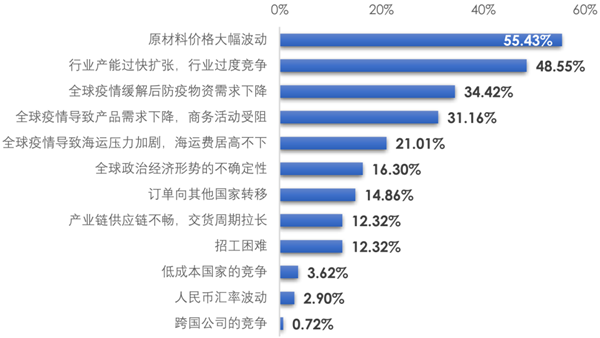
As for the main external challenges currently facing the industry, the problems reflected by the interviewed enterprises mainly focused on the large fluctuations in raw material prices and the excessive expansion of industry capacity, in addition, the decline in demand for epidemic prevention materials, business activities and high sea freight costs are also the problems reflected by enterprises (Table 4). The interviewed enterprises are generally optimistic about the competition from low-cost countries. Enterprises have strong confidence in their product quality, customer relationship and innovation ability, and have the confidence and ability to participate in global competition.
Table 4 Key external challenges faced by surveyed firms
Data source: China Industrial Textile Industry Association
5. Annual Development Forecast
At present, the domestic and international environment is becoming more severe and complex, the steady growth of the industry is facing many risks and challenges, and enterprises are generally more cautious about the expectations of the industry's full-year operation. According to the survey of the association, the confidence index of the interviewed enterprises is 54.8, which is in a relatively prosperous range. Among them, the enterprises of structural enhancement textiles, windsurfing textiles and transportation textiles are relatively optimistic about the development of the whole year.
In the second half of 2022, with a series of policy measures such as tax reduction and fee reduction, strengthening financial support, continuously optimizing the business environment, and increasing efforts to ensure the supply and price stability of energy and raw materials, it is expected that the industry's production is expected to resume growth throughout the year. The industry's operating income will return to the upward channel, and the decline in total profits will further narrow and is expected to return to the same period in 2021. The pace of investment in the industry will slow down and investment in new capacity will become more rational; the external demand market will continue to repair, and the export of traditional products will continue its good momentum.
Note: Since January 1, 2022, the customs codes of some commodities in the industrial textiles industry have been adjusted. Due to the lack of year-on-year data of the same caliber, the year-on-year growth rate of imports and exports of the industry released in this period is for reference only.
More information

Follow us
Hello, what can we do for you?
Copyright © Xiantao Dexing Plastic Products Co., Ltd / Xiantao Dexing Health Technology Co., Ltd | Powered by:300.cn
SAF Coolest v1.3.1.2 设置面板 FZUSD-ZSNG-OSSQE-ZWE
无数据提示
Sorry, the current column is being updated, please look forward to it!
You can view other columns or returnHome Page