


News Center
News Center
The global cotton market fluctuates frequently, how can textile enterprises win the first opportunity?
Release time:
2022-08-08
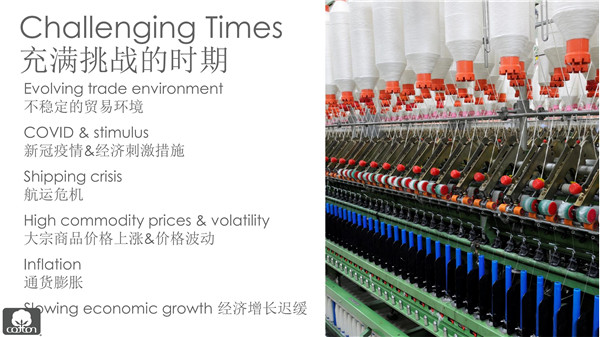
Under the influence of multiple factors such as macroeconomic downturn, shipping crisis, inflation and European war, the global cotton market is changing. In the face of changes, scientific analysis of cotton price data, dialectical view of the international situation, from the changing environment to capture the stable market law, will provide strong support for industry enterprises to explore countermeasures and achieve breakthrough against the trend.
Under the influence of multiple factors such as macroeconomic downturn, shipping crisis, inflation and European war, the global cotton market is changing. In the face of changes, scientific analysis of cotton price data, dialectical view of the international situation, from the changing environment to capture the stable market law, will provide strong support for industry enterprises to explore countermeasures and achieve breakthrough against the trend.
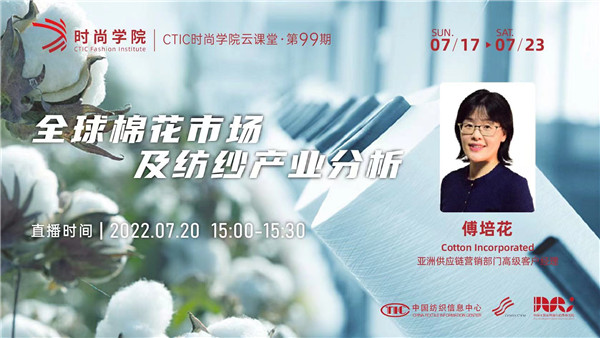
On July 20, Ms. Fu Peihua, Senior Customer Manager of Cotton Incorporated's Asian Supply Chain Marketing Department, in conjunction with China Women's Clothing Fabric Fashion Trend Research Institute, brought "Analysis of Global Cotton Market and Spinning Industry" through the live broadcast platform of "CTIC Fashion Institute". From a unique perspective of neutrality, Fu Peihua explained in detail the reasons for the recent fluctuations in the cotton market and the key factors affecting the future trend of cotton prices, and made a forward-looking analysis of the global cotton market trends to help industry companies improve market insight and actively respond New trends in the cotton market. In addition, she also focused on the distribution of global spinning capacity and the development of the past two decades to carry out in-depth sharing.
Insight into the market, interpretation of cotton price factors
Fu Peihua first combed a series of major events that have affected the cotton market in the past three years or so, and extracted the core factors that affect the future cotton price trend.
"Prior to the new crown, trade disputes had been disrupting the industry." Fu Peihua said that the United States is the largest cotton exporter and clothing importer, while China is the largest cotton importer and clothing exporter. The mutual increase of tariffs and the escalation of trade disputes between China and the United States have brought great uncertainty to the cotton market and inhibited the development of the whole market in a few years. Cotton prices fell during the Sino-US trade dispute. With the progress of the negotiations and the signing of the first phase of the agreement, the cotton market showed some signs of recovery in late 2019 and early 2020, with cotton prices rising to about 70 cents per pound. But with the outbreak of the new crown, cotton prices fell to nearly 50 cents per pound.
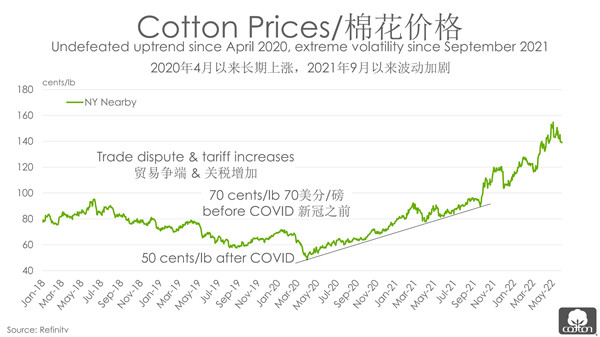
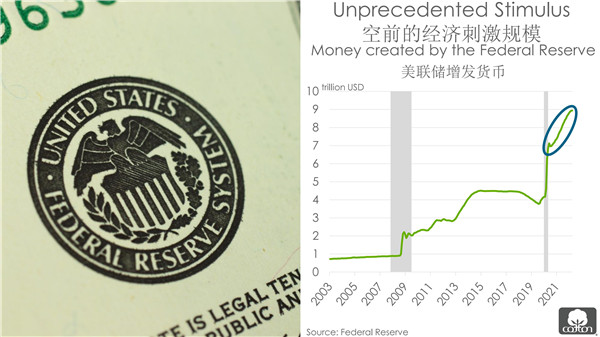
"However, shortly after the collapse in fiber prices, governments and central banks around the world introduced unprecedented economic stimulus measures. This was to prevent a collapse in asset values and reduce potential social unrest. Overall, these efforts have been successful. Asset values, including cotton, have climbed to pre-COVID-19 levels." Fu Peihua said.
"The shipping crisis will also have an impact on cotton prices." Fu Peihua added that from the perspective of supply and demand, the inventory consumption ratio of this year and 2017/18 is very close, but the price level is very different. The current cotton price is much higher than that of 2017/18. One of the reasons for the disconnect between cotton prices and supply and demand may be the shipping crisis. Even if cotton does exist somewhere, the inability to get it to where it is needed creates a scarcity of supply.
Professional research and judgment, forward-looking global cotton market development
Based on a thorough analysis of the factors affecting the trend of cotton prices, Fu Peihua focused on the supply and demand situation of the cotton market and studied and judged the development trend of the global cotton market.
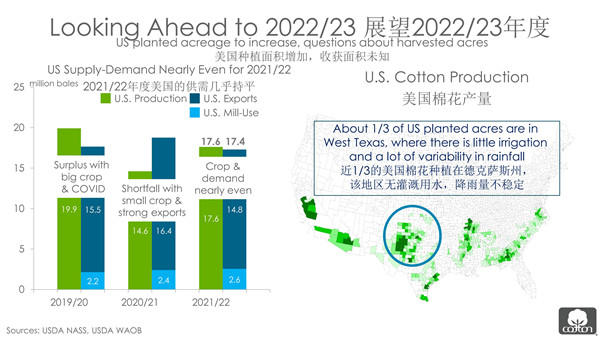
Fu Peihua analysis, for the upcoming cotton year, the United States supply constraints seem to be a major problem. Because of the drought in West Texas, the U.S. Department of Agriculture has predicted a decline in cotton production. The United States is the world's largest cotton exporter, which is likely to affect international cotton prices, but the increase is not expected to be as strong as the peak in cotton prices in 2011.
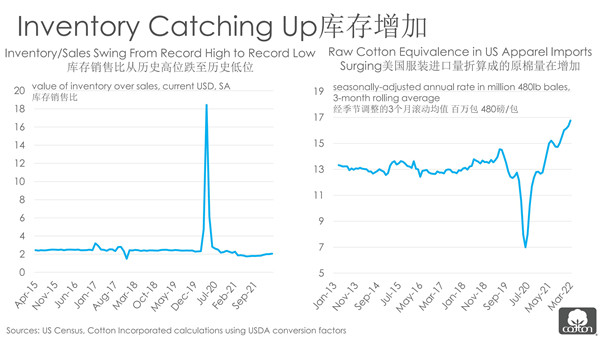
At the same time, the demand side of the cotton market is facing multiple problems. Fu Peihua mentioned that inflation is one of the core problems. As the prices of daily necessities such as energy, food, and real estate rise sharply, consumer demand for consumable goods such as clothing and home textiles will decrease, and clothing expenditures may fall, which will lead to an increase in retailer inventories and a decrease in orders. Downstream cotton demand is at risk.
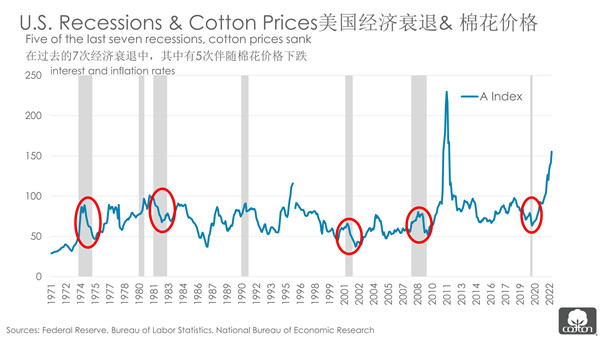
"Another thing to watch out for is the possibility of a recession." Fu Peihua said. Historical data shows that when the United States falls into an economic recession, cotton prices will respond. Global cotton prices have fallen in five of the past seven recessions. The prospect of a recession in the United States and slower global growth increases the likelihood of a shift in cotton prices. Falling cotton prices could devalue existing stocks, with the result being a financial crisis and order cancellations across the supply chain.
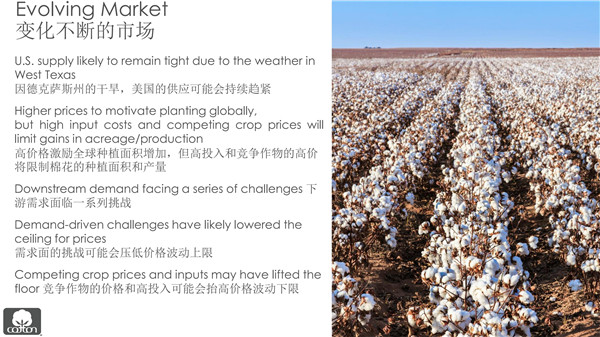
Inflation and rising interest rates will slow demand, and one positive effect this will have is the potential recovery of the logistics sector. The solution of logistics problems can ease the upward pressure on prices. "As the cotton market and macroeconomic conditions continue to evolve, uncertainty remains the main tone of the market." Fu Peihua stressed.
In-depth analysis, looking forward to the dynamics of spinning capacity.
Combined with the data released by ITMF (International Federation of Textile Manufacturers), Fu Peihua analyzed the distribution of global spinning capacity and the development of the past two decades, and further expounded the status and influence of China's spinning industry in the world.

"Among the three mainstream spinning technologies of ring spinning, rotor spinning and jet spinning, China is the country with the largest production capacity." Fu Peihua pointed out that with China's formal accession to the WTO at the end of 2001, China's ring spinning and rotor spinning capacity increased rapidly. At the beginning of 2000, China's ring yarn production capacity was only 35 million spindles and rotor spinning was only 620000 spindles. By 2010 and 2011, the production capacity of ring spinning and rotor spinning will both reach historical records, with ring spinning reaching 0.12 billion spindles and rotor spinning reaching 2.72 million spindles.
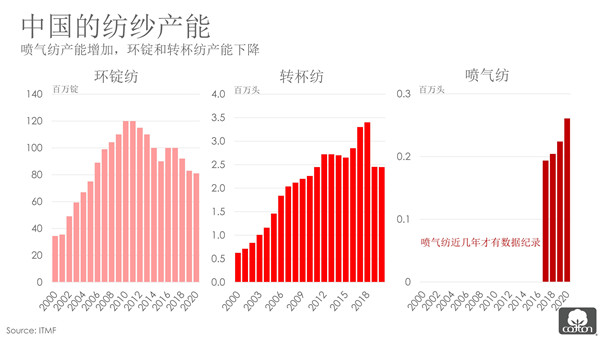
However, with the price of cotton reaching an ultra-high price of more than 30000 tons in early 2011, ring yarn production capacity and cotton consumption began to decline simultaneously. Over the next decade, the cotton and textile export markets have continued to face challenges. Fu Peihua said, in the cotton inside and outside the price difference is too large, the supply chain to Southeast Asia, the Sino-US trade dispute, the new crown epidemic and other factors, China's ring spinning production capacity scale decreased year by year. In 2020, China's ring-spun yarn production capacity was reduced to 83 million ingots.
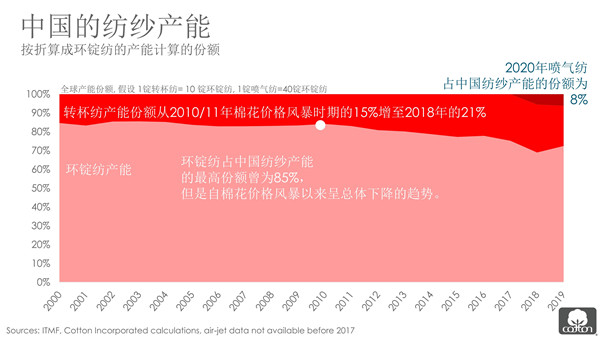
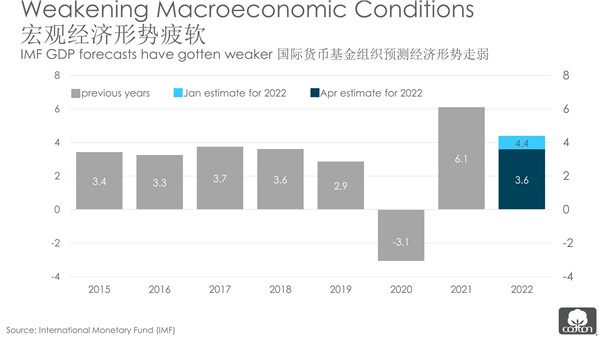
In recent years, China's air-jet spinning production capacity has grown rapidly. In 2020, China's jet spinning capacity share is 8%, higher than the global jet spinning capacity share, indicating that China's jet spinning development is faster than the global average pace. "But in fact, the future of the textile industry can continue to develop, whether production capacity will continue to expand, the most important thing is to look at the economy. At present we are facing a bigger challenge is the global economic growth is weak." Fu Peihua stressed.
Cotton Incorporated is a non-profit organization dedicated to the promotion of cotton products. It is funded by American upland cotton producers and cotton importers. The company's purpose is to increase the demand for cotton worldwide through textile technology research and promotion activities. And profitability. Cotton Incorporated has a world-class research center, actively engaged in new product development and product quality improvement, and the cotton economy, consumer behavior and market conditions to carry out extensive research, always tracking fashion and color trends.
Previous article
More information


Follow us
Hello, what can we do for you?
Copyright © Xiantao Dexing Plastic Products Co., Ltd / Xiantao Dexing Health Technology Co., Ltd | Powered by:300.cn
SAF Coolest v1.3.1.2 设置面板 FZUSD-ZSNG-OSSQE-ZWE
无数据提示
Sorry, the current column is being updated, please look forward to it!
You can view other columns or returnHome Page