


News Center
News Center
January-October 2021 China Industrial Textile Industry Operation Profile
Release time:
2022-01-10
At present, due to the continued spread of the mutated new coronavirus, many countries are forced to take emergency blockade measures again, thus increasing the uncertainty of the global economic recovery. China's industrial textile industry in the domestic distribution of epidemics, floods and limited production and power supply and other factors superimposed impact, especially by the impact of the same period in 2020 high base effect, January-October 2021 industry-scale enterprises above the industrial value added continued to decline, down 20.4 percent, but the two-year average growth rate is still 12.4 percent.
At present, due to the continued spread of the mutated new coronavirus, many countries are forced to take emergency blockade measures again, thus increasing the uncertainty of the global economic recovery. China's industrial textile industry in the domestic distribution of epidemics, floods and limited production and power supply and other factors superimposed impact, especially by the impact of the same period in 2020 high base effect, January-October 2021 industry-scale enterprises above the industrial value added continued to decline, down 20.4 percent, but the two-year average growth rate is still 12.4 percent.
In terms of production, the output of non-woven fabrics of enterprises above designated size reached 5.007 million tons from January to October, down 1.7 percent from the same period last year; the output of cord fabric was 673000 tons, up 26.9 percent from the same period last year.
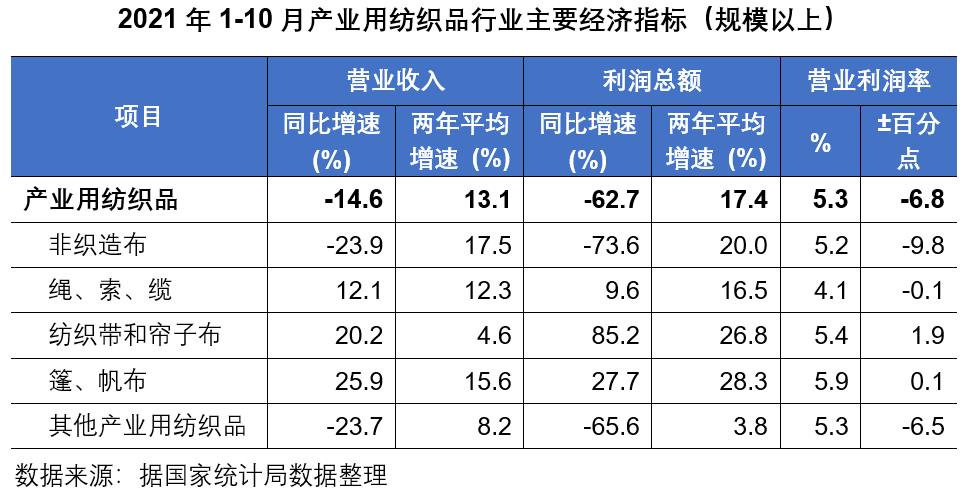
In terms of economic benefits, from January to October, the operating income of enterprises above designated size in the textile industry fell by 14.6 percent year-on-year, with an average growth of 13.1 percent in two years, total profits fell by 62.7 percent year-on-year, with an average growth of 17.4 percent in two years, and the operating profit margin was 5.3 percent, down 6.8 percentage points year-on-year. In terms of areas, the operating income and total profit of the nonwovens industry decreased by 23.9 and 73.6 respectively, and the operating profit margin was 5.2, down 9.8 percentage points from the same period last year; the operating income and total profit of the rope, cable and cable industries increased by 12.1 and 9.6 respectively, and the operating profit margin was 4.1, down 0.1 percentage points from the same period last year; the textile belt and cord fabric market has a good momentum of development, with operating income and total profit increasing by 20.2 and 85.2 respectively year-on-year, and operating profit margin reaching 5.4, up 1.9 percentage points year-on-year; the operating income and total profit of awnings and canvases increased by 25.9 and 27.7 respectively year-on-year, with the operating profit margin of 5.9 being the highest in the industry; the operating income and total profit of other industrial textiles where medical and health, filtration, and geotechnical textiles are located fell by 23.7 and 65.6 respectively year-on-year, and the operating profit margin was 5.3, a year-on-year decrease of 6.5 percentage points.
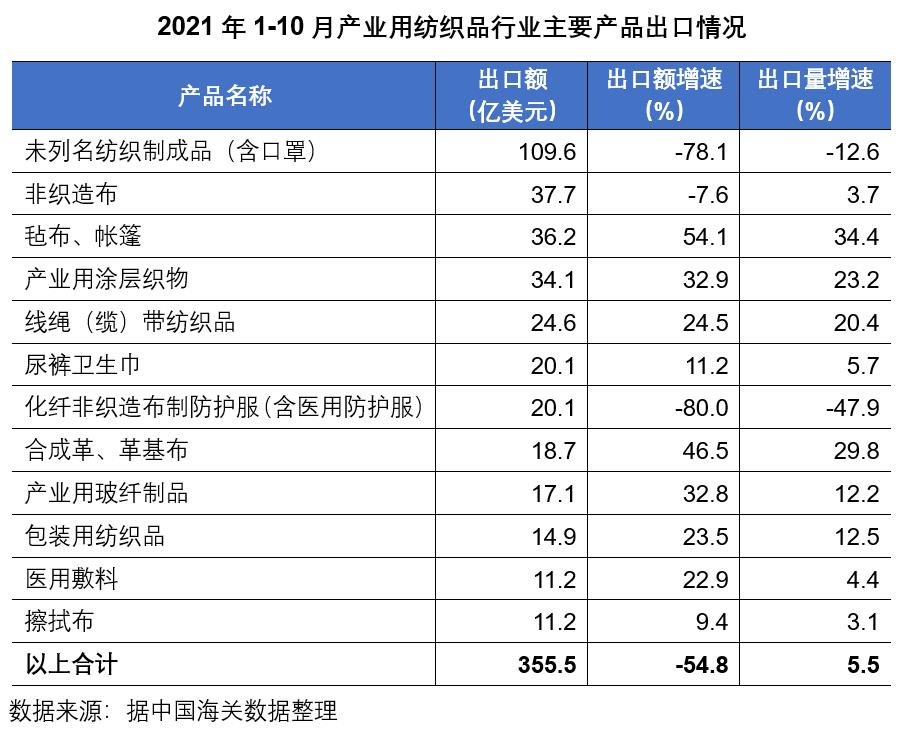
In terms of international trade, the export volume of major products in the industrial textile industry basically maintained a high growth rate from January to October 2021. In terms of export value, unlisted textile products (mainly masks) are currently the industry's largest export products, but their exports have fallen by 78.2 compared with the same period last year due to the sharp drop in foreign demand for masks. Exports of traditional products such as felt cloth/tents and industrial coated fabrics increased by 54.1 and 32.9 respectively. Exports of synthetic leather and leather-based cloth increased by 46.5 per cent. Exports of nonwovens and related products showed different trends, with coil exports of US $3.77 billion, down 13.1 percent from the same period last year; chemical fiber nonwoven protective clothing (including medical protective clothing) exports of US $2.01 billion, down 80.0 percent from the same period last year; and disposable sanitary products exports of US $2.01 billion, up 11.2 percent from the same period last year.
Note: The two-year average growth rate is the growth rate calculated using the geometric average method based on the corresponding period in 2019.
Previous article
Previous article
More information

Follow us
Hello, what can we do for you?
Copyright © Xiantao Dexing Plastic Products Co., Ltd / Xiantao Dexing Health Technology Co., Ltd | Powered by:300.cn
SAF Coolest v1.3.1.2 设置面板 FZUSD-ZSNG-OSSQE-ZWE
无数据提示
Sorry, the current column is being updated, please look forward to it!
You can view other columns or returnHome Page