


News Center
News Center
The Positive Impact of RCEP Agreement on Wool Textile Products Trade and Industry Integration
Release time:
2021-02-27
On November 15, 2020, during the fourth RCEP leaders' meeting, the ten ASEAN countries, China, Japan, South Korea, Australia and New Zealand formally signed the Regional Comprehensive Economic Partnership Agreement (RCEP), witnessed by Premier Li Keqiang and other leaders of 15 member countries. This marks the official launch of the free trade zone with the largest population, the largest economic and trade scale and the most potential for development in the world.
On November 15, 2020, during the fourth RCEP leaders' meeting, the ten ASEAN countries, China, Japan, South Korea, Australia and New Zealand formally signed the Regional Comprehensive Economic Partnership Agreement (RCEP), witnessed by Premier Li Keqiang and other leaders of 15 member countries. This marks the official launch of the free trade zone with the largest population, the largest economic and trade scale and the most potential for development in the world.
The RCEP agreement covers a market with 2.2 billion million people (nearly 30% of the world), US $26.2 trillion of GDP (about 30% of the world) and total exports of US $5.2 trillion, accounting for nearly 28% of global trade (based on 2019 data). This will strongly support free trade and the multilateral trading system, stabilize the regional industrial chain supply chain, and promote the recovery and development of the regional and world economy. Under the promotion of RCEP agreement, the development of China's wool textile industry and trade facilitation will be promoted accordingly, which will have a positive impact.
Wool spinning industry chain in RCEP region is complete
Close trade
The RCEP region covers the entire industry chain from wool production to product consumption. Australia and New Zealand are the main producing areas of wool, China and ASEAN are the main wool textile processing and manufacturing industries, and China, Japan and South Korea are all important consumer markets for wool textile products.
China is the largest export market for wool from Australia and New Zealand, ASEAN and Japan are the second and fourth export markets for China's wool products, and ASEAN is Japan's second largest import market.
In 2020, the total trade volume of wool textile raw materials and products (excluding carpets) between China and other RCEP member countries was 3.59 billion billion US dollars, accounting for 33% of the total trade volume. Among them, the export value was 2.08 billion US dollars, accounting for 28% of the total export value; the import value was 1.51 billion US dollars, accounting for 44% of the total import value. The orderly and convenient development of RCEP intra-regional trade is particularly important for the wool textile industry.
China's Trade with Other RCEP Wool Textile Raw Materials and Products in 2020
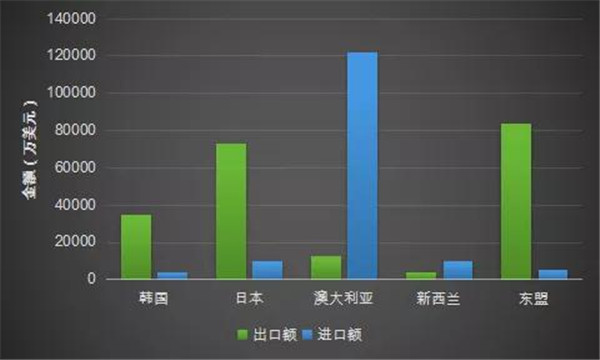
Image data source: China Customs
Free trade further expanded and deepened
Wool textile industry regional integration development will accelerate
RCEP is another important breakthrough since China has accelerated the implementation of the free trade zone strategy. Prior to this, China has signed free trade agreements with many RCEP member states. In 2008, the China-New Zealand Free Trade Agreement entered into force, in 2010, the China-ASEAN Free Trade Area was fully established, and in 2015, the China-Australia and China-South Korea Free Trade Agreements entered into force. Coupled with the free trade agreements between ASEAN and Japan and other regions, through these free trade agreements and the construction of free trade zones, wool textile products have achieved relatively free flow in the region from the production, processing and consumption of wool textile raw materials. With the signing of RCEP, China and Japan have also realized a new free trade partnership, and the expansion and deepening of free trade in the region will help to further promote the export of China's wool textile products and increase trade and investment exchanges.
The wool textile industry will further realize free trade and integration in the RCEP region. RCEP adopts regional cumulative rules of origin, which lowers the threshold for the determination of origin, making it easier for products in various regions to enjoy tariff concessions. It is helpful to strengthen the division of labor and cooperation among members and promote the further development of regional integration of wool textile industry.
RCEP helps upgrade China's wool textile products
Competitiveness in the Japanese market
Japan's annual imports of wool textile products exceed US $2 billion, of which China accounts for about 45%, making it the largest import market. Japan is also the fourth export market of China's wool textile products. In 2020, China's exports to Japan will account for 10% of China's total exports of wool textile products.
Japan's current import tariffs on China's major woolen products range from 2% to 10%. The tax reduction policy mainly adopts a gradual tax reduction method. The tariffs on woolen yarns, woolen fabrics, blankets and other products will be reduced to 0% within 11 years; tariffs on woolen knitted garments, woolen woven garments, woolen scarves and other products will be reduced to 0% within 16 years.
Tax Reduction Arrangements for Japanese Wool Products Imported from China
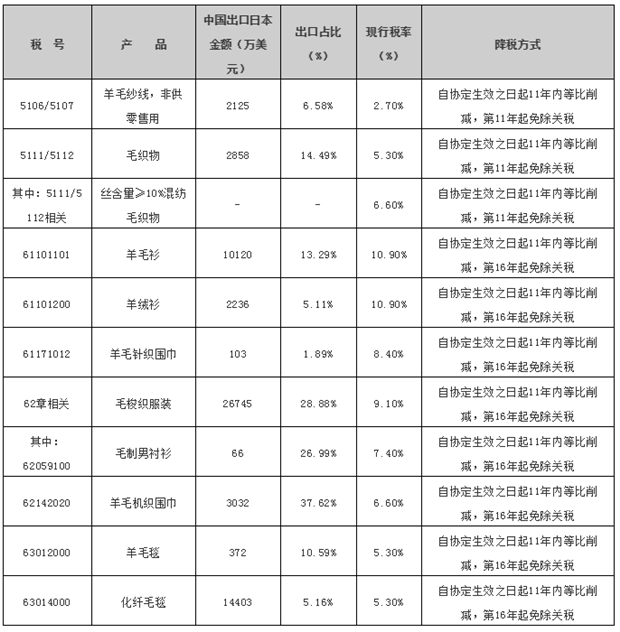
Source: China Wool Textile Industry Association
Since Japan has signed free trade agreements with ASEAN, India and other countries, the above countries' wool textile products imported into the Japanese market can enjoy duty-free treatment. Under the promotion of zero tariffs, Japan's imports of ASEAN wool textile products have increased year by year in recent years. In 2020, ASEAN imports accounted for 25% of Japan's total imports of wool textile products.
At present, the grades of wool textile products exported by China and ASEAN to Japan are similar. With the implementation of RCEP's tariff reduction policy, it will help improve the competitiveness of China's wool textile products in Japan.
China-South Korea Trade Enjoyed
preferential free trade agreement
South Korea is one of the important markets for China's wool textile exports. In 2020, China's exports to South Korea accounted for 5% of the total exports of wool textile products. China is also South Korea's largest source of imports of textiles and clothing, accounting for more than 1/3 of South Korea's annual imports of textiles and clothing.
The bilateral free trade agreement between China and South Korea has come into effect in 2015. In the past five years, the tariff of wool textile products has been reduced, and there has been a certain degree of preferential treatment on the basis of the general tax rate. According to the China-South Korea agreement, the main wool textile products will be exempted from tariffs in the next 5 or 10 years, which is already an optimal situation.
(Source: China Wool Textile Industry Association)
More information

Follow us
Hello, what can we do for you?
Copyright © Xiantao Dexing Plastic Products Co., Ltd / Xiantao Dexing Health Technology Co., Ltd | Powered by:300.cn
SAF Coolest v1.3.1.2 设置面板 FZUSD-ZSNG-OSSQE-ZWE
无数据提示
Sorry, the current column is being updated, please look forward to it!
You can view other columns or returnHome Page