


News Center
News Center
Brief Analysis of Economic Operation of Industrial Textile Industry in the First Half of 2019
Release time:
2019-08-15
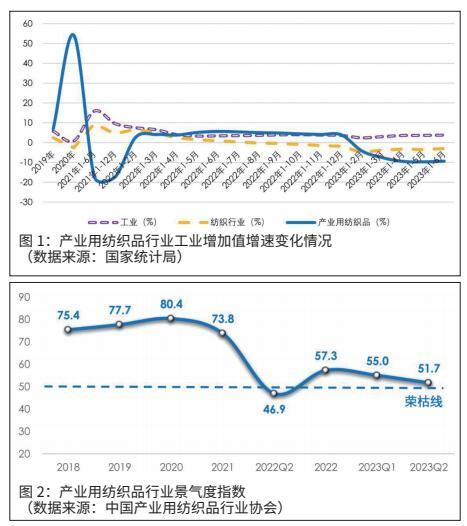
In the first half of 2019, China's economy is facing a complex development environment, with external trade protectionism and unilateralism headwinds, internal structural and cyclical contradictions highlighted, transformation and upgrading climbing over the hurdle, and increasing downward pressure on the economy. The industrial textile industry has overcome various unfavorable factors and maintained a stable operation. The industrial added value increased by 7.6. The main business income and total profits of enterprises above designated size increased by 6.32 and 1.49 respectively. The growth rate of the three indicators was basically the same as that of the same period last year. According to the survey of China Industrial Textile Industry Association, the prosperity index of member enterprises in the first half of the year was 69.5, which was the same as that of last year.
In the first half of 2019, China's economy is facing a complex development environment, with external trade protectionism and unilateralism headwinds, internal structural and cyclical contradictions highlighted, transformation and upgrading climbing over the hurdle, and increasing downward pressure on the economy. The industrial textile industry has overcome various unfavorable factors and maintained a stable operation. The industrial added value increased by 7.6. The main business income and total profits of enterprises above designated size increased by 6.32 and 1.49 respectively. The growth rate of the three indicators was basically the same as that of the same period last year. According to the survey of China Industrial Textile Industry Association, the prosperity index of member enterprises in the first half of the year was 69.5, down 8.4 from the same period last year, which is an objective reflection of the complex economic environment, but it is still in a relatively prosperous range.
1. production maintained steady growth
According to the Middle Class Coordination Institute,In the first half of the year, the demand index of enterprises 49.7,For the first time, it is in a state of contraction below the boom-bust line; among the companies surveyed, 34% of the companies said that market demand has declined to varying degrees, and 6.5 percent of the companies said that the decline is larger; 1/3 of the companies said that market demand is basically flat, and the other 1/3 The company believes that demand has increased. But the industry's production index remains 66.2 high, and the actual situation is better than the industry's judgment of demand.
According to the National Bureau of Statistics, the output of non-woven fabrics of enterprises above designated size was 2.162 million tons, a year-on-year increase.11.41%As an important raw material for industrial textiles, nonwovens are still in great demand in various fields,In the first half of the year, China exported 497000 tons of nonwovens, up 6.88 percent year on year.In the first half of the year, the output of cord fabric from enterprises above designated size was 295000 tons, down 9.83 percent from the same period last year. Cord fabric is a traditional product in industrial textiles. It is used in vehicle tires. The application market is very single. Subject to the downturn of the automobile market, the production of cord fabric is basically in a state of contraction in recent years.
2. economic benefits steadily pick up
According to the data of the National Bureau of Statistics, in the first half of the year, the main business income and total profits of enterprises above designated size in the industrial textile industry were 118.77 billion yuan and 6.02 billion yuan respectively, up 6.32 percent and 1.49 percent respectively over the same period last year, and the profit margin of the industry was 5.07 percent, down 0.24 percentage points. From the perspective of profit composition, the industry's gross profit margin was 14.07, a substantial increase of 0.5 percentage points over last year. The proportion of three fees was basically the same as last year, and the operating profit margin increased by nearly 0.5 percentage points. The factor causing the decline in industry earnings is not an operational factor, but an abnormal change in non-operating income and expenses.
In the first half of the year, the loss area of the industry was 15.52, and the loss of loss-making enterprises increased by 20.73. The changes in the macro situation still had a great impact on the operation of some enterprises in the industry. The research results of the association also confirm the relevant data. In the first half of the year, the industry's income index was 61, and the profit index was only 52.6. The output index is 66.2, but the price index of finished products is only 44.2. The growth rate of output is higher than that of income, and the growth rate of income is higher than that of profit. The growth in the first half of the year is mainly driven by output. During the same period, the tax and fee index of enterprises was only 44.2, which was in the downward range, indicating that the national policy of reducing fees and taxes has really benefited enterprises, and also ensured that enterprises maintained good performance under relatively difficult circumstances.
By field, the rope and cable industry's main business income and total profit growth rate was the highest, reaching 15.62 per cent and 17.01 per cent, respectively, with a profit margin of 4.94 per cent, at a relatively low level; other industrial textiles's main business income and total profit increased by 5.17 per cent and 3.38 per cent, respectively,Gross profit margin increased by nearly 1 percentage point.The main business revenue of nonwovens increased by 6.84, but the total profit decreased by 5.91, the profit margin was 5.03, and the profitability was at a relatively low level in recent years. The main business income of the textile belt and cord industry increased by 2.24, the total profit decreased by 3.73, and the gross profit margin decreased by 0.7 percentage points. The cost structure of the industry fluctuated greatly, and the profit margin was only 3.44, which was the lowest level in the industry. In recent years, the overall economic benefits of this field affected by the downturn of the downstream industry of cord fabric are not very ideal.
3. exports up slightly
In the first half of the year, my country's industrial textile industry exported a total of US $13.13 billion billion in various products, which was a year-on-year increase under the same caliber.1.23%. The impact of the U. S.-China trade friction on industry exports was already evident in 2019, with $2.04 billion billion in exports to the U.S. in the first half of the year,3.05 percent year-on-year declineEspecially for products that have been subject to tariffs.
In the first half of the year, the export of 56 products (nonwovens and special yarns) to the United States decreased.17.65%, Chapter 59 Products (Industrial Textiles)Exports to US down 28.6 percentGlobal exports of the above two chapters increased by 0.7 per cent and -1.61 per cent, respectively. In the U.S. import market in the first quarter, the share of Chinese products in both chapters was significant.Decrease by 6 percentage points. However, the United States in the above two chapters of China's export market share is not large, the impact of the reduction of exports to the United States on total exports is basically controllable.
For products that are not in the tariff list, such as non-woven protective clothing, tents, wipes and disposable hygiene products, global exports increased by 10.83, 6.04, 7.47 and 16.09, respectively, and Chinese products have a clear competitive advantage in the world. With the expansion of Sino-US trade frictions, the pressure on industry export growth will increase in the second half of the year.
In terms of export markets, Asia is the largest exporter of industrial textiles in China, accounting for 45.7 per cent of the total, 17.7 per cent and 17.2 per cent of the European Union and North America, and only 6.2 per cent of Africa. From a national perspective, the United States is my country's largest export market, accounting for 15.58 per cent of the total, while Japan and Vietnam rank second and third, accounting for 6.53 per cent and 6.02 per cent respectively.
4. full-year forecast
In the first half of 2019, the industrial textile industry has overcome various unfavorable factors and basically maintained a stable operation. It is expected that the situation in the first half of the year will continue throughout the year. The production and sales of major products will maintain medium-to-high-speed growth, industry profits will grow at a low speed, and exports will be affected by Sino-US trade frictions. The impact will grow at a low speed or even decline slightly.
(Source: China Industrial Textile Industry Association)
More information


Follow us
Hello, what can we do for you?
Copyright © Xiantao Dexing Plastic Products Co., Ltd / Xiantao Dexing Health Technology Co., Ltd | Powered by:300.cn
SAF Coolest v1.3.1.2 设置面板 FZUSD-ZSNG-OSSQE-ZWE
无数据提示
Sorry, the current column is being updated, please look forward to it!
You can view other columns or returnHome Page