


News Center
News Center
Operation Analysis and Forecast of Chemical Fiber Industry in the First Half of 2018
Release time:
2018-08-15
In the first half of the year, the chemical fiber industry was generally stable. International oil prices fluctuate upward, the cost of the chemical fiber industry to form a huge pressure, pushing up the price of the fiber market center of gravity. Although the growth rate of total profits was not as high as that of the same period last year, the overall operation of the industry was good. Each sub-industry operation differentiation, showing the situation of ice and fire, polyester, nylon industry performance is good, viscose fiber, acrylic and spandex industry operation is more difficult. Investment continued the rebound trend, production capacity is in a concentrated release period.
OnIn half a year, the chemical fiber industry was generally stable. International oil prices fluctuate upward, the cost of the chemical fiber industry to form a huge pressure, pushing up the price of the fiber market center of gravity. Although the growth rate of total profits was not as high as that of the same period last year, the overall operation of the industry was good. Each sub-industry operation differentiation, showing the situation of ice and fire, polyester, nylon industry performance is good, viscose fiber, acrylic and spandex industry operation is more difficult. Investment continued the rebound trend, production capacity is in a concentrated release period.
Basic Situation of Industry Operation
(I) supply and demand
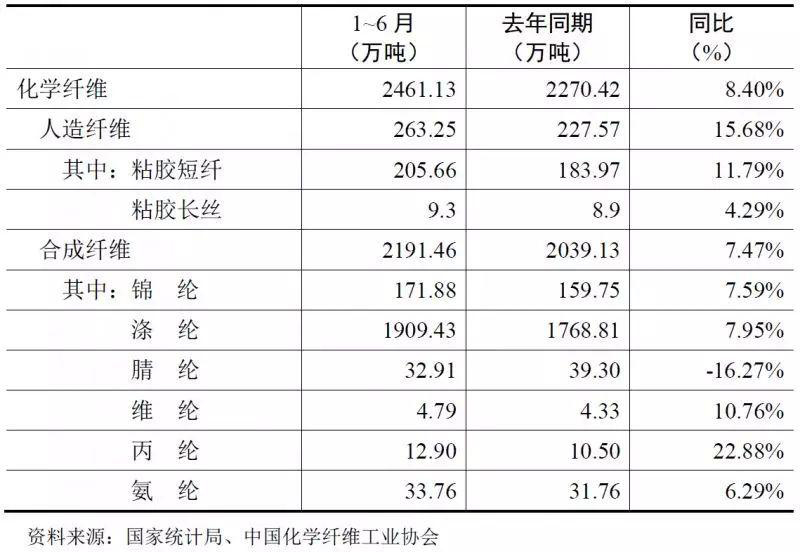
According to statistics from the National Bureau of Statistics, the output of chemical fiber from January to June was 24.6113 million tons, an increase of 8.4 percent over the same period last year. The average operating rate of polyester and nylon industry in the first half of the year was higher than 80%, and the operating state was better than that of other industries. The viscose staple fiber industry is affected by supply and demand, and the overall operating rate of the industry fluctuates between 80% and 85%, which is less than in previous years.
On the demand side, downstream demand increased year-on-year. In addition to cord fabrics, the output of downstream major products has increased to varying degrees year-on-year; the operating rate of downstream factories has also increased significantly compared with the same period last year; in addition, the total transaction volume of the textile city has increased by about 33% year-on-year, especially in April and May. It also shows that the demand for chemical fiber is strong. Due to good production and sales, the inventory of polyester and nylon industries is lower than that of the same period last year, maintaining a low inventory state, which is also a prerequisite for prices to be transmitted downstream.
Table of Chemical Fiber Output from January to June 2018
(II) Market
By the transmission of commodity prices, the price of synthetic fiber products in the cost-driven center of gravity is generally higher than the same period last year, of which polyester filament rose more. Due to the largest volume of polyester filament, it feels that the chemical fiber market is "rising", but in fact, the market conditions of each sub-industry are clearly differentiated, showing a situation of ice and fire, which can be summarized as "cost-driven rise, production capacity pressure type decline".
(III) Quality
In the first half of the year, the growth rate of the main business income and total profit of the chemical fiber industry gradually increased compared with the same period last year. Since May, the total profit has been reversed from negative growth to positive growth. Data from the National Bureau of Statistics show that from January to June, the main business income of the chemical fiber industry was 387.3 billion billion yuan, an increase of 16.27 percent over the same period last year, while the total profit was 17.8 billion billion yuan, an increase of 19.27 percent over the same period last year. The loss area of the industry was 21.92 per cent, an increase of 4.66 percentage points over the same period last year, and the loss of loss-making enterprises also increased by 22.21 per cent over the same period last year. The total profits of the industry and the losses of loss-making enterprises are increasing, indicating that the profitability of enterprises is more differentiated.
Economic benefits of chemical fiber industry from January to June 2018
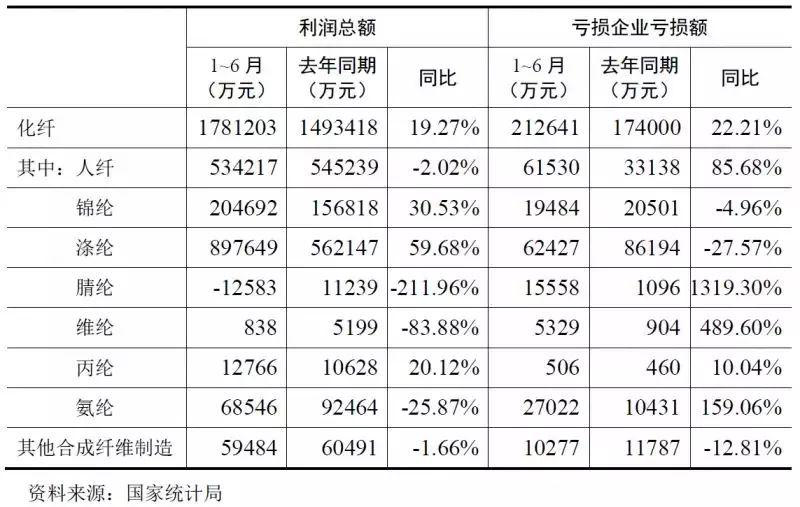
From the statistical data, the profits of the chemical fiber industry mainly come from the polyester, cellulose fiber and nylon industries, but the viscose fiber industry in the cellulose fiber industry is almost at a loss.
The operation quality of chemical fiber industry is generally good. From January to June, the profit margin of the main business was 4.6, an increase of 0.12 percentage points over the same period last year; the speed of asset turnover accelerated, and the proportion of three fees decreased. The increase in industry profits, from the market level, is mainly due to the rise in product prices and the follow-up of downstream demand, but its essence is that the supply-side structural reform has achieved results, the relationship between supply and demand has been improved, and the development of new products is also accelerating. The brand, quality, and variety have been improved.
Main factors affecting the operation of chemical fiber industry
(I) International oil prices
In the first half of the year, the international situation "unexpected" situation occurred frequently, political risks and supply fluctuations led to oil prices fluctuating upward, constantly hitting new highs. Rising oil prices are a double-edged sword. On the one hand, it provides strong support for chemical fiber prices and is conducive to corporate inventory surpluses, but on the other hand, it also pushes up production costs.
(II) Capacity
Driven by good benefits, the industry's investment enthusiasm has not diminished. In the first half of the year, the growth rate of fixed asset investment in the chemical fiber industry continued the rebound trend of last year, with a year-on-year increase of 28.2, and the growth rate increased by 7.9 percentage points over the same period last year.
New capacity release, backward production capacity exit, the industry is in the throes of shuffling. Among them: the new capacity of polyester industry is mainly dominated by large enterprises, the concentration is further improved, polyester short fiber benefits from the market of recycled fiber, nylon drawing capacity expansion speed is not as fast as raw materials, nylon industry operation improved, viscose short fiber and spandex industry new capacity on the market impact is greater, the industry operation difficulties.
(III) RMB Devaluation
Although the devaluation of the RMB is conducive to exports, the proportion of chemical fiber exports is still low. The chemical fiber industry is highly dependent on imports of raw materials, and the devaluation of the RMB will increase the cost of imports of raw materials.
(IV) Sino-US Trade Friction
In the first half of the year, Sino-US trade frictions gradually escalated. The first round of 50 billion product list does not include chemical fiber products; the second round of 200 billion list includes all chemical fiber products and most related products, and is currently in the public comment stage. In the short term, Sino-US trade friction has little direct impact on the chemical fiber industry, but we should continue to pay attention to the progress of Sino-US trade friction. Thinking from another perspective, challenges are also opportunities, which will force the industry to do a good job in high-quality development and focus on "practicing internal skills".
Industry operation forecast for the second half of the year
(I) demand
July-August into the industry's traditional off-season, demand may be weakened, but the downstream capacity has increased, September-October is the traditional peak season is still worth looking forward. On the export side, the intensification of trade protectionism and the escalation of trade frictions between China and the United States may lead to a shift in the external demand market or a decline in demand.
(II) crude oil
Only from the supply and demand side, OPEC countries will increase production, the United States crude oil production will continue to grow, the second half of the crude oil supply and demand pattern is likely to be a small surplus. A strong dollar will also put pressure on oil prices. However, the international oil price has been out of the marginal pricing period of shale oil, and the uncertainty of oil price has increased due to the constraints of the big country game.
(3) Operation forecast of chemical fiber industry
The further release of new capacity and the restart of some long-term shutdown devices will once again broaden the supply side. Demand growth may not be as good as supply growth, coupled with the instability of exports, the industry (polyester polyester) supply and demand balance may be broken. The devaluation of the renminbi will lead to rising costs of imported raw materials. It is expected that the second half of the industry will be less effective than the first half of the year.
More information


Follow us
Hello, what can we do for you?
Copyright © Xiantao Dexing Plastic Products Co., Ltd / Xiantao Dexing Health Technology Co., Ltd | Powered by:300.cn
SAF Coolest v1.3.1.2 设置面板 FZUSD-ZSNG-OSSQE-ZWE
无数据提示
Sorry, the current column is being updated, please look forward to it!
You can view other columns or returnHome Page