


News Center
News Center
Japan also "follow the trend" to raise taxes, Chinese textile export sellers or a new round of reshuffle!
Release time:
2018-08-09
Recently, the news that state governments in the United States levy consumption tax on cross-state sales of e-commerce has attracted much attention. With the promotion of comprehensive taxation of e-commerce in the United States, Germany, Japan and other countries have recently been rubbing their hands on e-commerce tax adjustments.
Recently, the news that state governments in the United States levy consumption tax on cross-state sales of e-commerce has attracted much attention. With the promotion of comprehensive taxation of e-commerce in the United States, Germany, Japan and other countries have recently been rubbing their hands on e-commerce tax adjustments.
Global trade war starts, Chinese sellers lose competitiveness in the United States?
U.S. Commerce Secretary Ross announced on May 31 that the United States will impose tariffs of 25% and 10% on steel and aluminum products from the European Union, Canada and Mexico from June 1. On July 6, the United States officially began to impose tariffs on $34 billion billion worth of Chinese goods. In response to this series of measures by the United States, the European Union, Canada, China and Mexico have all imposed retaliatory tariffs on American goods. These retaliatory tariffs are mainly targeted at U.S. agricultural, food and beverage products, because the United States does not export many manufactured goods except automobiles.
European Union
As a counter-measure to impose tariffs on steel and aluminum products from the United States, the European Union imposed a 25% tariff on US goods worth 2.8 billion euros (about 3.2 billion US dollars) from June 22, including Harley motorcycles. In order to avoid the tariff response from the European Union, Harley-Davidson motorcycle company announced on June 25 that it would transfer its product production line for EU countries to factories outside the United States. In addition, other products taxed by the EU include jeans, orange juice, tobacco, whiskey and peanut butter.
Many of the EU's tariffs target food and beverages, items that Europeans would not normally buy from U.S. sellers. As a result, the EU's retaliatory tariffs are likely to have a limited impact on U.S. e-commerce sellers who sell to EU countries.
Canada
In the face of U.S. provocation, the Canadian tariffs began on July 1, imposing tariffs on about $12.5 billion of U.S. exports. In addition, Canada imposes a 25% tariff on more than 40 U.S. steel exports and a 10% tariff on about 80 other U.S. goods, including maple syrup, coffee beans and jams. The direct impact of these tariffs on the e-commerce sales business of U.S. sellers is relatively limited, mainly sellers selling food have been affected.
Trump is considering imposing tariffs on imported cars and their parts from Canada. The automobile trade between Canada and the United States is worth $140 billion a year. The automobile industry is a highly integrated industry, and parts produced in one country are usually assembled into cars in another country. Canada said it would incur a reciprocal tariff response if the United States imposed such tariffs. However, this incident will not directly affect most e-commerce sales.
Mexico
In retaliation for higher U.S. tariffs on Mexican steel, Mexico imposed a 20 percent tariff on nearly $3 billion worth of U.S. products. The Mexican government took action on June 5 to eliminate preferential tariffs on certain products under the North American Free Trade Agreement (NAFTA), including U.S. pork, potatoes and whiskey. Mexico has imposed a 25% import tariff on U.S. pork.
Other U.S. agricultural products include apples, cranberries and cheese, as well as some U.S. steel products are on the tariff list, and most of the products on the list will face tariffs of 15% to 25%. These tariffs will not significantly affect the e-commerce sales of U.S. merchants to Mexico, because the products subject to tariffs in Mexico are usually not purchased online.
China
So far, the United States has imposed tariffs on $34 billion billion worth of Chinese exports. Most of these are U.S. companies that buy industrial components exported from China and then assemble them into finished products at home, mostly in the B2B market. Trump has even threatened to impose tariffs on another $200 billion of Chinese exports, and has said he is willing to tax the entire $505 billion of Chinese exports (as of 2017). This will extend far beyond the industrial supply chain and into automobiles and finished consumer goods.
In response, China imposed a 25 percent tariff on U.S. agricultural exports, particularly pork and soybeans. Previously, China bought about 60 percent of U.S. soybean exports worth about $12.4 billion a year. Currently, China is buying soybeans from Brazil.
Because Americans buy a lot of Chinese-made consumer goods online, including clothing and consumer electronics, cross-border e-commerce will be hugely negatively impacted if the U.S. continues to tax all Chinese imports. For American consumers, goods made in China will become more expensive, because businesses are unlikely to absorb the sharp rise in costs on their own.
In addition, Chinese e-commerce companies such as Alibaba and Jingdong, which are starting to attract American consumers, will also be negatively affected by the tariffs.
If U.S. goods are affected by China's potential retaliatory tariffs, the competitiveness of U.S. e-commerce sellers selling in China will be greatly reduced. Merchants who sell luxury goods are more relaxed, because these goods usually do not use Chinese raw materials. In 2017, the United States exported $130 billion worth of goods to China. This is a very important number. It is about 1/4 the value of China's exports to the United States.
Compared with other countries involved in the trade war, China has more bargaining chips. Although Sino-US relations are faltering in the trade war, China holds US $1 trillion worth of US Treasury bonds and is the largest overseas creditor of the United States. If the Fed stops buying new bonds or sells its holdings, it will trigger a rise in yields, putting pressure on the U.S. government's debt burden. The Chinese government may also make it more difficult for U.S. companies to operate in China and impose stricter regulations on them.
Japan to raise taxes and fees? Chinese export sellers may suffer a new round of reshuffle
Recently, a number of Amazon Japan sellers reported to this website that they had received an email notification about "reports related to consumption tax amount and MWS API specification changes". The content pointed out that for the convenience of sellers and to cope with future tax reform, the platform will change the website specification to start displaying consumption tax amount. Currently, it is planned to start the specification change on August 30, 2018. If there is any change in schedule, will inform the seller.
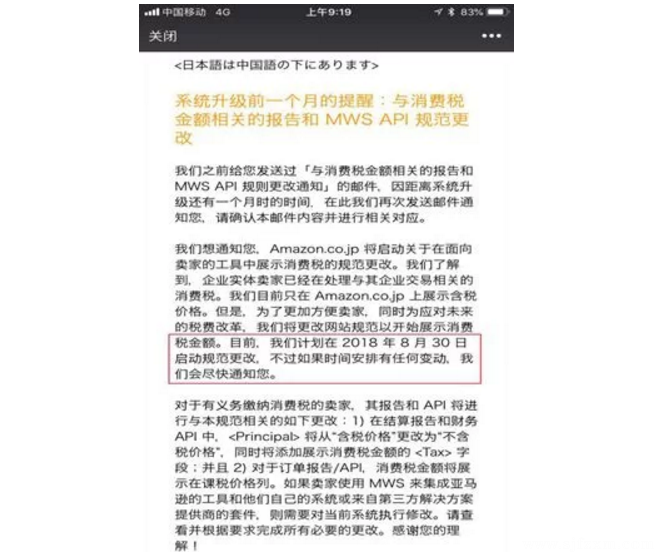
(seller screenshot)
As soon as this news came out, there were different opinions among sellers. Should Japan carry out tax adjustment? How much impact will it bring to Chinese export enterprises? What kind of situation will it bring to cross-border e-commerce in the future?
Japan's tax adjustment is mainly used for education, the site has followed the seller's most worried about is the United States and Asia station
In fact, as early as the beginning of August 2017, Japanese Prime Minister Shinzo Abe made it clear in a program on Japan's Yomiuri TV that the consumption tax would be raised from 8% to 10% in October 2019. This website has also done related reports on this. Now Japan's tax adjustment may be put on the agenda, which is enough to show the general trend of tightening its tax reform policy.
According to Zhang Jiong of Guangdong Cross-border E-commerce Industry Association, Japan's next consumption tax increase is aimed at all retail industries, including online and offline, import and domestic. Therefore, the e-commerce industry is treated equally. Chinese sellers need not worry too much. "As far as I know, the 2% increase in Japan's consumption tax is mainly used to support education. Japan is also a country that attaches great importance to education, the use of consumption tax on education is also supported by the general public in Japan. It can be seen that for Chinese companies whose products are exported to the Japanese market, the impact is minimal." He said.
"On the contrary, the increase in Japan's consumption tax will increase the tax cost of goods imported from Japan to China to a certain extent, and the cost will also increase for imported e-commerce platforms, Japanese Haitao and Japanese tourism purchasing agents. However, if Japanese products are exported to other countries (not sold in Japan), there is no need to pay consumption tax."
In the face of the increasingly complex situation in overseas markets, how should Chinese sellers rise to the challenge?
Wang Suxiang suggested that "it is wise for enterprises to go out to sea and choke the throat of trade from the logistics link. Taking the Japanese market as an example, companies can register a company in Japan, and then send a large number of goods to the local area through general trade, and store them in overseas warehouses. After the local buyers purchase, they will directly ship the goods locally, and the speed will also change. It is faster. Through B2B, it can not only open a larger market, but also avoid the problems that may occur in various B2C links."
In a word, "in the face of increasingly severe global tax supervision situation and more fierce market competition environment, what is more tested is the sellers with real guns. Chinese sellers need to follow the trend, adjust their strategies, innovate practices and actively respond." Wang Suxiang said.
More information


Follow us
Hello, what can we do for you?
Copyright © Xiantao Dexing Plastic Products Co., Ltd / Xiantao Dexing Health Technology Co., Ltd | Powered by:300.cn
SAF Coolest v1.3.1.2 设置面板 FZUSD-ZSNG-OSSQE-ZWE
无数据提示
Sorry, the current column is being updated, please look forward to it!
You can view other columns or returnHome Page